What does Bill 132 (Sexual Violence and Harassment Action Plan Act) mean to you and your workplace?

One in four women and one in ten men say they have experienced some form of sexual harassment in the workplace. Of the reported cases of workplace sexual harassment, 55% were committed by co-workers; 39% of which involved a supervisor or manager. 8% of those who are sexually harassed at work report the harassment.

Recently there have been some changes made to Bill 168 – Violence in the Workplace, which gives employers’ statutory obligations. Bill 132, Sexual Violence and Harassment Action Plan Act, which received royal assent on March 8, 2016, requires all employers to have policies and programs including an investigation procedure. The essential changes brought by Bill 132 include: an employer is required to create a workplace harassment program; the program must include reporting and investigating tools for incidents of workplace harassment and violence; the employers must ensure that all complaints are investigated, and investigations are completed in a timely fashion and a new power to the Ministry of Labour (MOL) to order an independent workplace harassment investigation at the employer’s expense.

September 8, 2016, now looms for companies as the date for compliance with Bill 132. The amendments stand to change dramatically how workplace harassment is addressed in Ontario. The new OHSA obligations and expectations have been set and are accompanied by expanded government oversight. Harassment in the workplace is already a challenging issue that could engage multiple forums, with complaints possibly being advanced through a grievance, civil claim, complaint under the Human Rights Code, and, depending on the severity of the conduct, the criminal justice system.

Also, and particularly, the Bill amends the OHSA to require an employer to conduct an investigation of a workplace harassment complaint that is “appropriate in the circumstances.” The phrase “appropriate in the circumstances” is not defined. Further, the Ministry of Labour has not published any guidance material to communicate what factors will be considered by inspectors when determining whether an investigation meets this standard. Assuming that the inspectors could be evaluating investigations against expected best practices which would include such things as an impartial investigator, a collection of all relevant information, and procedural fairness to the alleged harasser could create challenges for employers as the appropriateness of an investigation may be evaluated in hindsight.

Consequences of flawed investigations would impair or prejudice the employer’s ability to establish just cause for termination or discipline. There would also be an issue of due diligence under the OHSA and Human Rights Code. Consequences would include aggravated, punitive or Code damages; penalties from the Ministry of Labour under the OHSA and reinstatement in unionized workplaces. Some of the critical mistakes some employers are making include: failing to act at all; taking the complaint seriously; failure to train investigators; inability to plan, improper or inadequate files; and retention of evidence.

Many situations happening in the workplace may prompt the necessity for an investigation, such as allegations of discrimination or harassment, workplace bullying, inappropriate use of the internet or social media, policy breaches, or statutory violations. Often, employers attempt to resolve minor issues informally through discussions with the employees involved. When the allegations are more serious, employers may depend on managers to conduct internal investigations. However, in many situations, having an organization deal directly with the problem is not necessarily the best approach – informal discussions may rapidly collapse, and basic investigative steps may be overlooked by inexperienced managers, making matters worse. A vital skill for any employer is identifying when a formal investigation by an external investigator is appropriate.

Note: meeting the requirements of Bill 132 could lead to mistakes that can be costly to your organization.

Be prepared. Be proactive.

Contact Monika Jensen, Principal Aviary Group at [email protected]  or (905) 683-9953 if you need a complaint investigated or mediated.

Share

Embracing Civility for a More Satisfying WorkPlace

Complaints of harassment, discrimination, bullying and now violence and disrespectful workplaces have become a standard concern for managers and Human Resources specialist. As we cope with the many arising situations, I have found the word incivility is becoming frequently used. So what does incivility mean? To define it, let’s look at how the Institute of Civility describes it. Civility is about more than merely being polite. Civility requires a profound self-awareness being characterized by true respect for others. Civility involves the tremendous hard work of remaining present even with those with whom we have inherent and perhaps fierce differences. It is about continuously being open to hearing, to learning, to teaching and to changing. It pursues mutual ground as a start point for discussions when differences may occur, while at the same time be aware that differences are heartening. It is persistence, grace, and strength of character.

Recently research has expanded our practical understanding of incivility by identifying behaviours which employees have deemed disrespectful. The most frequently occurring forms include: neglecting to turn off cell phones; talking behind someone’s back; doubting someone’s judgement, using demeaning or disparaging language, gestures or behaviours; communicating with the intent to belittle or degrade, eye rolling, giving the silent treatment and using sarcasm; gossip and slander; paying no attention or ignoring someone; taking credit for someone else’s work or ideas; intimidation by intentionally using fear to manipulate others. It may also include yelling, invading personal space, throwing things, slamming things and losing one’s temper; and sabotaging by setting someone up to fail or intentionally creating a situation to make another person look foolish or incompetent. Also may include hate-ism by deliberately pointing at a victim based on age, gender, race or sexual orientation are instances of profiling because of an “ism.”

Many examples include blaming others rather than accepting responsibility; checking email or texting during a meeting; using email to send a difficult message to avoid facing the person, which may be misunderstood and misinterpreted; not saying “please” or “thank you”; not listening and talking over or down to someone.
The cost of incivility is high. It is not only about money! There is research to support impacts on performance through lost time and absenteeism, lack of creativity, less helpfulness and less likely to assist another employee. The impact of teams is on the level of energy, emotional engagement, and performance. The conduct reaches into our physical health; impacts our customers and commitment to the organization and willingness of employees to stay with their companies. All affecting the bottom line of productivity.
So how do we address these issues? I would like to explore some recommendations for your consideration. It starts with us as individuals. Managing ourselves. How? If you throw a ball at the wall…it comes back. It works with people too. If you are, mean…it comes back! People will be mean to you.

How can you be kind and patient all the time when life is so stressful—and just plain hard? You do it by embracing civility! Civility requires self-awareness.

With self-awareness you can:
 Control your attitude
 Manage your moods
 Choose behaviours that do not negatively impact your life or disrupt those around you

Can you…
 Feel and express annoyance, irritation or frustration without hurting others— and then let it go?
 Accept and even appreciate that other people have needs and opinions which are different from your own?
 Encourage and enjoy the successes of others?
 Recognize when someone else feels irritated, upset or frustrated and keep yourself from reacting impulsively in response?

As leaders, we need to model. The Russian novelist, Leo Tolstoy wrote: “Everyone thinks of changing the world, but no one thinks of changing themselves.” Employees look to leaders for guidance and someone to aspire too. What are they seeing? Watch your language and put away your smartphones when engaging with your staff. Be mindful of the perils of emails and other electronic communication. Pick up the phone or set up a face to face meeting instead. Take immediate and corrective action when warranted. Rude and disrespectful behaviours emerge quickly and sometimes without warning. As the leader, you need to respond at the moment. By delaying a reaction or action, it sends out mixed messages to the offender as well as the entire team. Take all complaints seriously, realizing that coming forward by the individual is difficult, and they need to know they are supported.

We attend seminars and workshop on harassment prevention, Creating Respectful Workplace and Violence in the Workplace. I have put together a workshop on “How Embracing Civility can Create More Satisfying Work Environments”. The agenda is:
• Why Civility Matters
• It Starts with You!
• Do What You Say and Say What You Mean
• Good Fences Make Great Neighbours
• Working in the Salad Bowl
• Eliminate Gossip and Bullying
• You Can’t Always Get What You Want
• Taking It to the Extreme
• Paving the Path to Civility

Contact Monika Jensen, Principal, Aviary Group, at [email protected]  if you are interested.

Share

7 Common Bidder Issues

At a session I attended a couple of years ago the City of Mississauga’s procurement department identified these common bidder issues.

  • How to find bid opportunities
  • Who to Contact
  • Onerous Requirement & Lengthy Bid Documents
  • Not enough information
  • Not enough time permitted to respond
  • Bid Rejections – doing all the work only to have it rejected
  • Perception of Secrecy

Sound familiar? I imagine you can all relate to these concerns and they are often the very reasons why many consultants and professionals shy away from, or simply no longer respond to, price-based RFPs for professional services. Detailed pricing just takes a lot of time and responding to a RFP can cost respondents a lot of money in lost time alone.

This is the first in a series of informational articles/blogs on these common bidder issues.  I will be tackling each of these issues separately and will be offering suggestions on how you can address them throughout the series.

The first one:

How to Find Bid Opportunities

Municipalities have limited advertising budgets so the days of posting their bid opportunities in the local paper have all but disappeared, except perhaps where required under a trade agreement or their own procurement by-law. The reason is that hard copy advertising is probably the most costly way for municipalities to advertise bid opportunities – plus it’s not a very effective way either because the ads don’t necessarily reach their target audience – which is the professionals they want to respond.

Most municipalities now have a Bids/Tenders section on their own municipal websites and they will post any bid opportunities they have in that location of their own website. This works well if you’re a local consultant who only wants to work in a geographic area near your business but it would be far too time-consuming to check 444 individual municipal websites daily for new bid opportunities.

To get broader exposure for their bid opportunities, and ultimately to acquire more competitive quotes, many municipalities now post their RFPs on outside websites – like muniSERV.ca, specifically designed for RFPs for consulting/professionals services, or bids&tenders, etc. for construction and other RFPs.  This enhances openness and transparency in the procurement process, helps municipalities target their advertising directly to the professionals/vendors they’re trying to reach and increases the number and quality of quotes they receive.  Bidders pay a fee to use such sites but they do help professionals/vendors find and access hundreds of bid opportunities daily – plus they offer automated email notifications that will notify members when a RFP has been posted that matches the service they provide.

How a municipality advertises their bid opportunities varies but it should be set out in their procurement or purchasing by-law, or in a policy that forms part of their procurement by-law. Most municipalities will have their procurement/purchasing by-law posted in the by-law section of their websites, so if you want to check how a specific municipality in which you’re looking for work advertises their bid opportunities, you can get a copy of their procurement by-law from their website.

Larger projects with certain value thresholds which are subject to certain trade agreements will have specific advertising and notice requirements. Under such agreements procurement opportunities must be advertised for a minimum number of days, irrespective of the advertising method used. Again, the project value thresholds, the number of days and how they will be advertised can be found in the municipality’s purchasing/procurement by-law.

In the municipal sector procurement is a dynamic, sometimes complex process. It is governed by contract law as well as various statutes.

But as you can see there are a variety of ways to find bid opportunities. It all comes down to your preferred method and the time and money you want to spend on finding them.

Susan Shannon is Principal of muniSERV.ca.  Earlier in her career she was a municipal Chief Administrative Officer (CAO) and as a result she understands first-hand the challenges faced by both municipalities and professionals/vendors in public sector procurement.  Connect and follow her on LinkedIn, join the muniSERV LinkedIn Group or reach her at 855 477 5095 or [email protected].


Share

Are You Looking for Municipal Data?

Data Analysis

A Quick Tip for Finding Municipal Statistical Data

As municipal consultants we constantly have the need to research municipal operations and data. But have you ever had difficulty finding it all in one location?

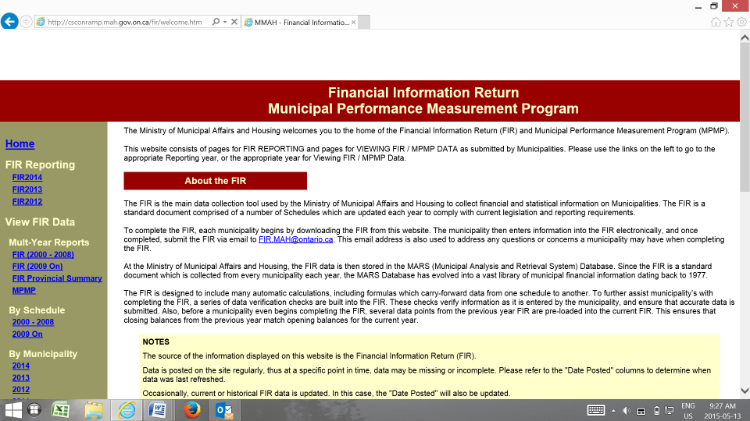
My method of choice to research and collect such information for Ontario municipalities is to use the Ministry of Municipal Affairs Financial Information Return (FIR) site. There is a wealth of information available on this site: http://csconramp.mah.gov.on.ca/fir/welcome.htm.  Here is what the site looks like.

Financial-Information-Return

Municipalities in Ontario are mandated to report their annual operations to the Ministry of Municipal Affairs by submitting a Financial Information Return (FIR) by May 31st, for the preceding year – so for example, their 2014 FIR must be submitted soon.

You can search for information in a variety of ways – By Schedule, by Municipality, Provincial Summaries or Multi-Year Reports. I most frequently search Schedule 40 of the municipalities I am needing to compare, because it contains their expenditures which are categorized into the nine (9) main municipal operations. For my particular purposes, I also tend to frequently look at the Municipal Data, Schedule 10 – Revenues, Schedule 20 – Taxation Information and Schedule 80 – Statistical Data, which includes staffing numbers. There are however, a number of other Schedules you can search to find the specific information you may need.

The one caveat I must mention though, is that although municipal operations can be similarly categorized, there is no way to ensure that a municipality is consistently reporting their information in the same category as another municipality. So, if you are comparing municipalities and a number seems too high or too low in comparison, you should always seek clarification from the municipality to be certain you’re comparing apples to apples.

I can only speak to what I’m familiar with here in Ontario, but I suspect a similar reporting requirement exists between all Canadian municipalities and their respective provinces.

If you’re a consultant or other professional in another province, does your province have a similar municipal database?  I would be interested in learning about it so I can share it with our professional members.

Or if you use other methods to find municipal data, I’d love to hear about them too.  We all need data – so why not help each other find it!

Susan Shannon – [email protected] Susan’s experiences as both a municipal Chief Administrative Officer, and now as a consultant, led to the development of muniSERV.ca .  Her experiences have provided her with the insight she needs to help municipalities and professionals connect.

Designed by Freepik

Share

What is your Asset Management Plan?


What is your Asset Management Plan?


After nearly ten years in and around Municipal Government, I understand the pressures you are face. Staff turnover, increasing administrative and operational demands, and reduced outside funding are just some of the significant pressures municipalities are facing. Unfortunately, the forecast isn’t so rosy either.  The aging workforce, deteriorating infrastructure, and will only make things more challenging in the years to come.  This is why it is more important than ever to get the most value out of each and every dollar spent by developing and implementing an Asset Management Plan.


What is Asset Management Planning?


Prioritizing needs over wants by ensuring timely investments in infrastructure.


Needs for an Asset Management Plan     

  • Aging and decaying infrastructure
  • Higher expectations from the public regarding levels of service
  • Higher health and safety standards
  • Increased regulations
  • Growth

Top Benefits of an Asset Management Plan

  • Reduces unpleasant surprises
  • Helps in achieving consistent levels of service
  • Helps in establishing policies and benchmarks for performance
  • Provides for easier budgeting
  • Reduces Municipal risk

·          All Federal Government Gas Tax recipients will be required to have an Asset Management Plan in place by March, 2018.


Develop a clearer picture of the state of your assets by developing an Asset Management Plan. You and your stakeholders will be better informed about asset operation, maintenance, and renewal decisions.


Contact Richardson Municipal Solutions today for your free Asset Management assessment.

Share