The Five Key Facets of High Performance Leadership

What makes a good or even a great leader?
Many people in leadership positions struggle with understanding what makes a good or even great leader. While billions of dollars are spent annually on leadership development, quality leadership is still in short supply.

Organizations have responded to the demand for effective leadership with a steady stream of education and training resources, which seem to be plentiful, (for example, at the time of writing, Amazon.com had over 9,000 references on leadership), yet most attempts at building high-performance leadership are either far too complex or too simplistic to be of any practical use to leaders who need to make things happen. So what does work?

While successful organizations focus on three imperatives: aligning strategy & people; developing world-class leaders; and building world-class teams, when we look at what successful leaders personally do to succeed, we find that they concentrate on building their capacity around what we call five key facets of leadership:

Focus – Authenticity – Courage – Empathy – Timing

Focus

Effective leaders stay focused on the outcomes they wish to create and don’t get too married to the methods used to achieve them. They provide this ‘outcomes focus’ for their organization by emphasizing the mission, vision, values and strategic goals of their organization and at the same time building the capacity of their organizations to achieve them.

This capacity-building emphasizes the need to be flexible, creative and innovative and avoid becoming fossilized through the adoption of bureaucratic structures, policies, and processes. It also means letting go of lines of business, products, and programs that don’t support the focus.

Authenticity

Leaders who are authentic attract followers, even leaders who are viewed as being highly driven and often difficult to work for. Simply put, they are viewed as always being themselves.and therefore followers know what to expect from them and can rely on them, come thick or thin.

Authenticity provides the leader with the currency to obtain ‘buy-in’ from key stakeholders, because it builds and maintains trust. Authenticity is the bedrock upon which the other facets are built.

Courage

The challenges facing leaders today are immense and require great courage to overcome. Leaders are constantly being challenged by others, be it their own team, customers, the public or stakeholders. Standing firm in the face of criticism, yet having the courage to admit when they are wrong, are hallmarks of courageous leaders.

Also, shifting an organization from being introspective to becoming customer-focused requires courage when people pay lip service to the new direction…it means calling people on their bluff.

Empathy

Effective leaders know how to listen empathetically. thus legitimizing others’ input. By doing so, they promote consensus building and build strong teams. They coach others to do the same, and so create a culture of inclusiveness. They tend to be great listeners who capitalize on the ideas of others and provide recognition for these ideas, yet they don’t get bogged down in overly complicated dialogue.

While they create learning organizations that place a high value on dialogue and continuous feedback, they know when to take action, when to ‘fish or cut bait’, which brings us on to the fifth facet…

Timing

The one facet that can make or break a leader is in knowing when to make critical decisions and when not to. All of the other facets must be viewed as subservient to getting the timing of critical decisions and actions right. There is a need to be focused, authentic, courageous and empathetic, but get the timing wrong on critical decisions and everything else stands to be nullified.

Great leaders move with appropriate speed. They don’t believe that everything must be done immediately…they know how to prioritize, and how to get their team to prioritize. As well, they engage in timely follow-through to ensure actions that are committed to happen in a well-coordinated and timely way.

Is that all it takes to be a great leader? These facets of high-performance leadership are not exhaustive. Just as one would look at the facets of a diamond, upon closer observation other facets become observable.

Any person can aspire to be a great leader by starting with these facets. If you are in a leadership role, regardless of your position in your organization, start by asking yourself the following key questions:

Key Questions
1. How focused am I? How much of my time do I spend communicating and inspiring people about our mission, vision and strategic goals? How much focus do I create in my organization? How married am I/my organization to methods that have outlived their usefulness?

2. Am I viewed as authentic? Do people see and hear the real me? Do I wear a mask at work, and remove it when I leave each evening?

3. How courageous am I when my values, vision, and goals are challenged? Do I stand firm and only change my position when I know that I am wrong?

4. How empathetic am I? Too much/too little? Do I create enough opportunities for open and candid dialogue? Do I ever find myself getting bogged down in consensus building, or leading my team to false consensus? Is there a feeling of inclusiveness and engagement amongst the members of my organization, and with other stakeholders, including customers?

5. Do I make and execute decisions in a timely fashion? Do I know when to ‘fish or cut bait?’ – do I demand well-coordinated and timely execution of strategy from others?

What can you do to create a high-performance leadership culture? Asking these questions in a candid way will open up many possibilities for you, your organization or your clients…if you have the courage to do it. Building and sustaining a high-performance leadership culture takes time, patience and a clear focus on the vital few characteristics that leaders can develop naturally and authentically.

Listening to what people expect from you as a leader, and then responding empathically, in a timely fashion, will move you dramatically towards mastering these five key facets of high-performance leadership.

Above all, you need to TAKE ACTION.


About the Author

Brian Ward is co-founder and CEO of Affinity Consulting and Training. Based in Edmonton, Alberta he provides leadership and management development to organizations in the private and public sectors throughout Canada.

Receive a free downloadable copy of his book Lead People…Manage Things: Master The Five Key Facets of High-Performance Leadership when you subscribe to his weekly newsletter Monday Morning Mentor.


Share

Top Business Apps: 15 Apps That Will Make You Insanely Productive

Testing out the top business apps to use as a freelancer can take a lot of time. The good news though, is that I’ve done the work for you!

After spending several years as a self-employed biz owner myself, and working with a team of 3-4 people, I’ve tested out lots of different tools and apps to help streamline our business process.

This has allowed me to be more productive, as well as earn more money in less time.

From managing financial goals, to working with clients, to balancing everything on the go, we all want to work smarter not harder.

Likewise, you have big business goals and to accomplish them you need some serious apps to be more productive. And you want tools that stop you from wasting a lot of time and money!

To that end, here are the top business apps that will make you insanely productive so you can run your biz like a boss. They can help you make your business a massive success this year!

Read the whole article here to find out these time-saving tips!

By: Carrie Smith Nicholson

https://www.carefulcents.com/

Share

North Carolina County loses Millions to Business Email Compromise and Phishing

North Carolina County loses Millions to Business Email Compromise and Phishing

Written by Michael Castro, vCISO and founder of RiskAware

Late last year, Cabarrus County in North Carolina fell victim to a crafted email asking to change banking information for a contractor with whom they had started business earlier that year. Within 3 weeks, the County had sent more than 2.5 Million dollars to who they thought was their contractor. It wasn’t.

It took a few more weeks to discover that they had been compromised. When the dust settled, the County was able to recover some funds, including a mere $75 000 from insurance, but even now, more than 1.7 Million remains unaccounted for.

Last year, losses to business email compromise topped 1.2 Billion dollars. As such, it is clear how an easy scheme can net quite large returns, and why it is so popular amongst cyber thieves.

Just the month previous, the city of Griffin in Georgia lost $800 000 in a compromise scheme.

Email as a process is not enough to deal with impersonation email, email fraud and wire transfer processes. Municipalities need to build new processes with checks in place to prevent the easy route of email compromise and fraud. Changes to account payable processes, proposer cybersecurity planning and education can all greatly improve the chance of such a scheme being caught before any money is lost.

Municipalities should also consider bring in cybersecurity experts to help with governance, compliance and process models that go beyond technical security controls and systems. For those government groups that have smaller budgets set aside for cybersecurity, a fractional or virtual Chief Information Security Officer (vCISO) is a good resource to help plan and build a more resilient cyber presence within a budget and capability of the municipality.

RiskAware is a boutique Cybersecurity firm, specializing in Security Governance and Strategy, assisting organizations of all sizes with security and risk advisory services and security-on-demand capabilities. RiskAware and its founder Michael Castro also provide fractional CISO services

RiskAware can be contacted at [email protected] or visited at www.riskaware.ca


Share

What is the difference between LEADERSHIP and MANAGEMENT?

In short: leaders create risk, and managers reduce it.

LEADERSHIP ANTICIPATES THE BEST OUT OF PEOPLE, AND MANAGEMENT ANTICIPATES THE WORST. While leadership invites others to follow, management ensures the followers are following.

Leadership is the act of inviting others to a new and better future.  A leader inspires and creates change by casting a vision of a destination that is different, better, and achievable.

Management is the ensuring things happen by creating, communicating, and monitoring expectations.  It tracks individual people to see that they perform as expected, as opposed to inspiring a number of them. 

Leadership skills can be summarized as those skills relevant to interacting with large groups of people, and to inspiring and creating vision. Conversely, management skills are those which are relevant to interacting with individual people, and to specifying and monitoring performance.

Many of the skills required to lead people are also the ones used to manage people. However, the expression of these skills can be significantly different.  For instance, a leader needs to effectively communicate to be compelling and inspirational, and a manager needs to effectively communicate to be precise and personal.

Because of the skillset overlaps between management and leadership, it is quite possible that a single person assumes either of these roles.


Want to learn more about leadership?  Check out EVERYTHING YOU NEED TO KNOW ABOUT LEADERSHIP.

Share

Why You Should Become an Asset Management Coordinator

Asset Management Coordinator – have you heard this of this career before?  

Well, if you haven’t, you’re about to hear a lot about it from municipalities over the next little while.  

Many municipalities are facing challenges to fund their infrastructure at levels that ensure their sustainability. With ageing assets, increased renewal needs and pressures from changing climate there is a need to do things differently and collaborate to address the “infrastructure gap”.

The end goal is for municipalities, provinces, and the federal government to leverage asset management planning to optimize infrastructure investment decisions. For example, in December 2017, the Province of Ontario passed O.Reg 588/2017 that sets out new requirements for asset management planning for municipalities.  

This makes the need to hire Asset Managers and/or Asset Management Coordinators, even more important and urgent. Therefore this is a rapidly growing and expanding career in Canadian municipalities.

So what is asset management and why do municipalities need an Asset Management Coordinator?


What is Asset Management?


Asset management refers to the systematic approach to the governance and realization of value from the things that a group or entity is responsible for, over their whole life cycles. It may apply both to tangible assets and to intangible assets. Asset management is a systematic process of developing, operating, maintaining, upgrading, and disposing of assets in the most cost-effective manner.


What kind of background and training do I need to have for this career?  


Many asset managers have engineering, finance and/or planning backgrounds but another key criterion is Project Management, as addressed in a recent Public Sector Digest webinar, “Hiring an Asset Management Coordinator”, sponsored by muniSERV/muniJOBS, as being integral to the success of someone looking to enter this career. 

Municipalities reported that core competencies should be there but much more important is that you can tell them how you’d add value to the position. Because this is an emerging field, you have a great deal of liberty to build the position as you go.  Articulate it in your cover letter. You may not have all the skills right now but if you’re willing to learn, municipalities are willing to provide you with the right training to do the job.

Top skills reported are;

  1. Willingness to learn on the job
  2. Systems thinking
  3. Relationship building and
  4. Communications skills.


At present, there are no courses available at universities, although, the Municipal Finance Officers’ Association of Ontario (MFOA)and Public Sector Digest can help.

For municipalities looking for an Asset Manager or Coordinator, muniJOBS has some candidates with Asset Management listed as one of their skills. To search candidates, simply register for a free Employer profile.

Share

5 Ways to Deal with a Bad Boss

Dealing with a bad boss

Bad bosses can be deadly. One 15-year study found that when employees had a difficult relationship with their boss, they were 30% more likely to suffer from heart disease. Perhaps really bad bosses have lower coronary disease because their hearts are seldom used!

If you have ever said, “My boss makes me sick!” you might be right. A British study found that stress induced by a bad boss lowers immune response, and participants were more susceptible to a cold virus.

As with much in life, it’s not what happens to us, but what we do about it. A bad boss might victimize you, but you choose whether to be a victim. Strong leaders don’t wait, they initiate. If you have a bad boss, you can decide that he or she’s not unbearable and live with your situation, fire your boss by leaving, or practice upward leadership with some boss management.

Boss management or leading upward is one of the most popular topics on our website. Recently The Globe & Mail published my column on Five Ways to Deal with a Bad Boss in their Leadership Labs section. I condensed years of writing and coaching on this topic into five steps:

  1. Strengthen your credibility and relationship
  2. Check your timing and approach
  3. Don’t wait, initiate
  4. Speak up
  5. Fire a bully boss

Click here to read the column for a brief description of each step.

A reporter once asked the Dalai Lama why he didn’t hate the Chinese Communists. Now they have some bad bosses! The Dalai Lama replied, “They have taken over Tibet, destroyed our temples, burned our sacred texts, ruined our communities, and taken away our freedom. They have taken so much. Why should I let them also take my peace of mind?”

Share

Thinking about thinking….

Daily we are required to make decisions, recall facts, and balance risks, whether at work or at home.

All of this requires considerable thinking yet we don’t really pay much attention to how we do that. Is it because its so easy or because it is so hard????

Let’s explore….

If we were to ask a friend or colleague “What is capital of France?” most will quickly come up with the right answer. Paris, of course. Easy question and not a lot of effort goes into finding the answer. The same goes if I were to ask you to spot the pattern in this series of numbers 122333….?? Yes, you got it. 4444.

But what if you were asked to come up with the answer to 15 x 24 without using your phone/calculator? If you are like most people, this question requires you to pause and think hard. If you were good at math in school you might be able to recall a shortcut or you just might have to get out pen/paper and figure it out the old-fashioned way. Unless you are a math superstar, it will be difficult to come up with the answer quickly but, given time, we can all do it.  The answer btw is 360.

If you consider yourself in the top 1% in terms of math abilities and are still feeling comfortable, here is my favourite math challenge of all time:

·       A bat and ball cost $1.10 to purchase

·       The bat costs one dollar more than the ball,

·       How much does the ball cost?

Allow me to keep you in suspense as you mull that one over. The answer is at the bottom of the page.

What these mind exercises illustrate is something that Daniel Kahneman refers to as “Thinking, Fast and Slow”, which happens to be the name of his best-selling book from 2011. Kahneman, who is now in his mid-80’s, is acknowledged to be the father of the field of behavioural economics. As a trained psychologist, and proudly not an economist, he has always been considered an iconoclast in his field of study. Along with his now deceased partner, Amos Tversky, he has spent a lifetime studying and gaining insight into how the human mind behaves.

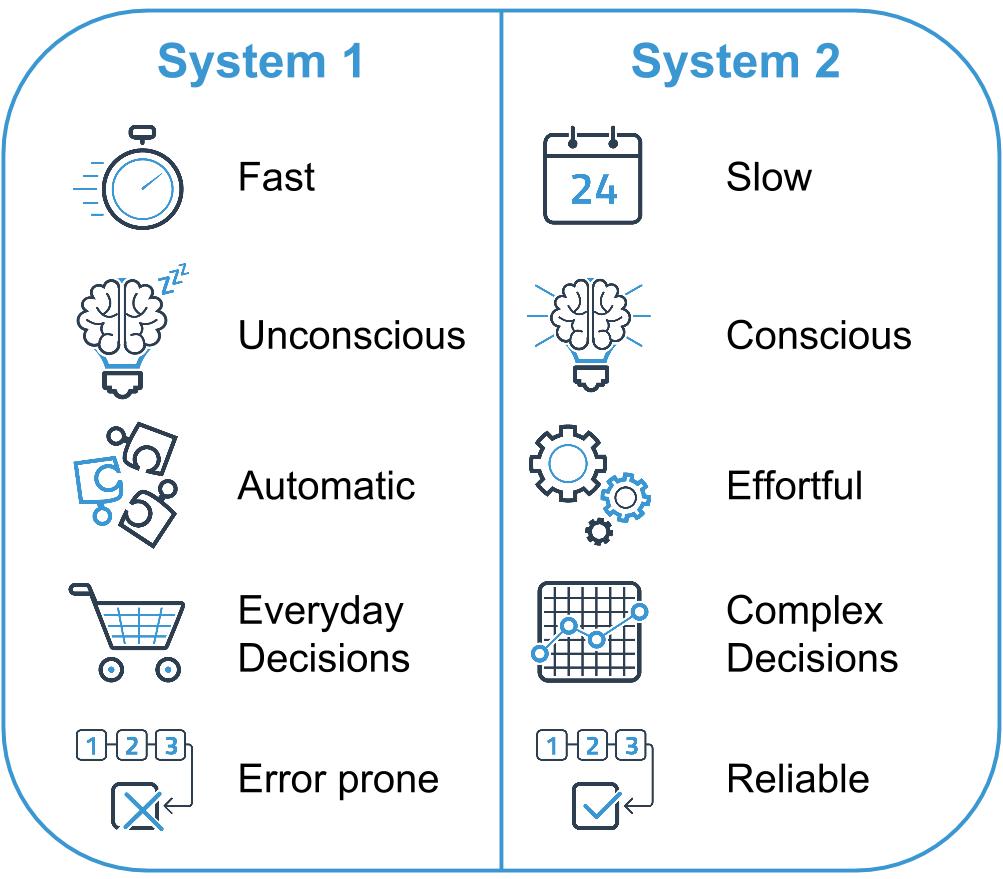
As a result of their ground-breaking studies, Kahneman and Tversky came to realize that there are actually two systems at play in our brains which affect our reasoning, judgement and decision making:        

·       System 1 operates automatically in the background at all times. It is quick and intuitive requiring little or no effort to come up with an answer. System 1 allows us to answer “Paris” to the question about the capital of France. When we use this system to think we are looking for patterns and meaning from the information at hand. Consequently, it is prone to mistakes. We can easily make judgment errors and fall victim to bias and are generally unaware of these errors when they happen.

·       System 2 kicks in when System 1 can’t provide the answer, like in the example of 15 x 24. This type of thinking is necessarily slow and deliberative. It requires great effort and we have to pay careful attention. It works best when it tests and checks results from System 1. It too can be prone to errors if we become distracted and lose our focus on the task at hand.

As someone who has spent their career helping colleagues make important procurement decisions there is much we can learn from Kahneman and the study of the human mind.  How often have we seen rushed evaluations and distracted evaluators lead to the wrong contractor being selected and poor project outcomes?

That is not to say that evaluations need to be dragged out unnecessarily. The use of enabling technology and more effective evaluation methods can make a huge impact and result in better overall outcomes, while still being completed in a timely manner. I advocate for drafting more effective and efficient evaluation schemes. On your next RFP, consider asking suppliers to respond in a structured manner to avoid having evaluators engage in an endless cycle of page flipping as they seek to find the pertinent information.  Try using enhanced consensus scoring where you focus only on the differences in scoring that exceed a pre-determined variance. We often spend too much time debating the merits of a 6 vs 7 and too little time trying to reconcile significant differences of opinion. Finally, spend the time to adequately prepare and train evaluators, even those who have previous experience. Awareness of how the mind operates and the pitfalls to avoid can go a long way towards a better outcome.    

In closing, here are my top advice tips to evaluators:

·       Be prepared to invest the time necessary to the task

·       Don’t rely on your fellow evaluators to bail you out

·       Slow down your thinking and avoid the rush to judgment

·       Pay attention to the details

·       Use critical thinking

·       Be respectful of other viewpoints during consensus meetings

·       Be aware of your biases – everyone has them


·       When relying solely on intuition, pause and use slow thinking to check/recheck the result

The ball costs $0.05

https://www.wayfinderconsultinginc.com/


Share

Applying Good to Great in the municipal sector

Full confession – I am a huge fan of the now old book (published in 2001), Good to Great by Jim Collins. The book is a study on how companies distinguished themselves as being great, when they started out as good. It included examining the 40-year performance of 1,435 good companies to find only 11 that became what Jim Collins would define as “great.”

In this day and age of big data, the results are even more relevant and compelling than they were then, and the increasing expectations of municipalities to re-invent the way they do business begs a long look at this book.

Now you’re probably saying, “That book talks about private companies and the public environment is much different.”

In many ways, I agree with this sentiment. But, in the desire to continuously improve and perform better, the concepts translate very nicely – a fact Collins addressed in 2005 in a follow-up book, Good to Great and the Social Sectors.

Upon reading both of these books, I was motivated to share my thoughts on how one might apply the learnings to the municipal sector.

Learn about the Six Elements to Achieving Greatness by reading the full article.

Kelly Rudyk was previously the Director – Corporate Planning for Strathcona County. His current work with It’s Logical Strategic Planning Services includes corporate strategic planning, business planning, and budgeting, and he is driven by continuous improvement.

He can be reached at [email protected] or 780-893-5635.


Share

Are You Doing it…To…For…or…With…Your Team?

Are you manipulating your team

Many studies have shown the impact that control of our situation has on our health, happiness, and effectiveness. In one experiment a white-footed deer mouse was placed in a brightly lit cage. The mouse could press a bar to alter the light. The mouse reduced the lighting to a dim level. The next morning experimenters set the lights to dim. The mouse immediately stepped up the lighting to bright. The mouse didn’t seem to care about its level of lighting. The critical issue was having control.

Another autonomy and control experiment was in a nursing home. One floor of residents were allowed to rearrange their room layout, schedule their time, and given a plant to keep and look after. Another floor or residents were told about all the good things being done for them. The staff arranged their room, scheduled their time, and gave them a plant that the nurse looked after. Eighteen months later, the residents on the floor with more control were more active and healthier than their controlled peers. Only 15 percent on the control floor died compared to 30 percent on the other floor.

Countless organizational studies show that autonomy, participation, “having some say,” and a modicum of control in the workplace are vital to employee engagement. Here are a few ways you can engage your work teams:

  • Develop a regular Listen-Feedback-Action process. This generally starts with a survey or third party interviews or focus groups. The outside company then prepares a summary report. This is reported back to everyone in the organization for feedback, clarification, priority-setting, and action planning. Broader organizational issues are identified, and actions set for implementing those changes. This is reported back to everyone and part of an ongoing process.
  • Coach team members to enrich their jobs and align their personal strengths, passions, and organizational or job needs.
  • Engage frontline service providers in a systematic process of identifying changing customer expectations against your team or organization’s performance. Get their help in analyzing trends and planning to meet those shifting needs.
  • Hold regular breakfasts (“muffins with management”), lunches, and celebration dinners with frontline teams. Take this time to ask for feedback, concerns, and suggestions. A simple question such as: “What’s the dumbest thing we do around here?” can produce powerful insights and engage people in resolving the issues raised.
  • Keep highly visible scoreboards, big thermometers (like a fundraising campaign), bulletin boards, web sites, blog/Twitter posts, newsletters, and the like to update everyone on your progress toward key goals or change and improvement targets. Make goals/targets and progress as visible as possible.
  • To get partnering behavior, treat everyone like partners. Share financial and other “confidential” information openly so everyone can see how his or her efforts contribute.
  • Ask frontline service providers what systems and processes would better help them serve your customers. Get their involvement in prioritizing the areas to be changed and improving them.
  • Send personal thank you notes (on real notepaper, not by e-mail); make detours to offer a verbal “thanks again,” and make lots of supportive phone calls.
  • Use focus groups (a cross-section of frontline staff) to test new management directions before making grand announcements to everyone. Even if you press on against the advice of the focus groups, you’ll have deeper insight on how to face the issues the new direction may raise.
  • Promote those people who are exemplary leaders. Use 360 feedback and other input from a variety of people to get a profile on their leadership effectiveness. Promotions send the clearest signals about the true culture of an organization. Are you promoting your cultural standard barriers?

Resistance to change often frustrates managers. But most of us enjoy change — especially for the better. What we resist is being changed. Effective leaders “do it with” their team or organization rather than doing it to or for them.

Share