Four Budget Visuals That Help You Tell Your Story

Whether you have new council members, a new ratepayers’ group or increasing cost pressures, communicating financial information effectively can make the difference between adopting a budget in three meetings or three months. 

It can be tough though; people collapse municipal services and property taxes with other agency’s services and taxes, and services are easy to take for granted.

This budget season, let pictures do the work. Here are four images you can add to your budget presentation to help tell your story about why costs are increasing and how public money is spent.

1. Capital Has Changed

Why the increasing focus on capital? Local governments own most of the public infrastructure in Canada now – that means covering lifecycle costs, asset management, preventative maintenance and more. Try using this graphic depicting the transfer of assets to local governments to illuminate newer financial responsibilities.  

2. Project Commitments: Funded and Approved

Looking for a way to connect council-approved projects with annual funding?

Senior Management Team, meet the iceberg. It’s a graphic metaphor one Canadian city manager used to describe the growing number of projects council approved, announced without a funding plan, (also known as projects that were ‘below the [funding] line’) and deferred. The image highlights which projects the council-directed tax increase pushes forward to future years and the risk that political talk does not match budget walk.


3.  Demonstrate Value Through Better Billing

Are there special programs or project costs council wants to highlight? Separating an infrastructure levy from the operating levy on the tax bill can be an effective way to highlight costs. The City of Mississauga’s bill identifies three such levies for the City of Mississauga highlights three special levies: The Emerald Ash Borer Management Program (a tree pest), Capital Infrastructure and Debt Repayment and the University of Toronto Mississauga Campus.  

4.  Municipal Services are Bodily Services

Tired of comparing the cost of services to the cost of a cup of coffee to communicate that municipal services are good value for money? Try this instead: The services we provide are important because they support everyone’s bodily functions. Every shower, flush, cereal box and bike ride involves local services.


This budget cycle, give elected representatives the gift that keeps on giving: a metaphor about how far municipal tax dollars go with an hourly reminder from their own body.  

Enter your email here to get these images sent to you in a PowerPoint slide deck.

What other budget metaphors, pictures and visuals have you come across that help communicate specific program costs or macro/micro capital shifts?


Emily Harris has worked in municipal finance policy as an academic at Carleton University, as the Manager of Policy at the Municipal Finance Officers’ Association, as a Management and Policy Consultant in the Toronto City Manager’s Office, as a Financial Analyst in the City of Toronto’s budget division and as a private consultant, completing projects for Local Authority Services (LAS) and the Ontario Government ministries of finance and municipal affairs. As Director of The Policy Shop, she specializes in financial policy updates for local governments and can be contacted at [email protected]

Share

Succession Planning: From Piecemeal Programs to Integrated Strategy

Succession planning steps

Studies show a growing sense of urgency for succession planning. One survey found 92% of respondents felt it was risky not to have a succession plan for key employees but only 25% of companies feel they’ve identified adequate successor candidates and less than half have a process for developing candidates. Other research shows 70% of executives think their organization lacks adequate bench strength while nearly 75% of senior managers will retire by 2020. An HR software study reported that over 90% of millennials say working at a company with a clear succession plan would “improve” their level of engagement. Another report found that promoting internal leaders has a success rate of 70-80% while the rate for external leadership hires drops to 50% — about the same as flipping a coin.

Many organizations recognize the critical need for succession planning. But the way they’re approaching this talent development challenge is with piecemeal programs. Too often internal support specialists such as HR, OD, or Talent Management professionals manage the program. They focus on tools like the 9 box grid, competency models, and organization charts. These tools are highly useful. But they’re severely limited when they’re bolted on the side of the senior leadership team’s crazy-busy agenda.

In high-performing organizations, tools and approaches like succession planning are owned and driven by the senior leadership team. They understand that implementation of their strategies and plans are highly dependent on culture development. Talent and leadership development are a vital strategic issue as vigorously managed as sales, marketing, operations, or finance.

Executives often check out (and start checking their email) when a deck of slides is read to them on succession planning tools, models, and processes. But if the senior leadership team is engaged in rich discussions on what their succession issues are and how to address them, they’ll quickly shift from passive approvers of their support staff’s plans to active leaders and drivers of the process. This becomes even more effective when senior leaders link succession planning to their strategy and culture.

Here are key steps for bringing a senior leadership team into alignment in moving succession planning from bolt-on programs to a built-in strategic process:

  1. Establish foundational frameworks for leadership/culture development grounded in research.  Examples: Excellence/culture models, Performance Balance, or 5 Steps to High-Performance Culture.
  2. Agree on a shared vision of your desired culture.
  3. Set/refresh the three or four core values anchoring your desired culture.
  4. Define the behaviors that model each core value and the negative behaviors that create eye-rolling “yeah, right” reactions to each core value. The clearest signal of an organizations lived (versus espoused) values is who gets promoted for what behaviors.
  5. Use a safe and anonymous process to identify moose-on-the-table (or elephants in the room) and what must be dealt with to move toward your desired culture.
  6. Agree on three or four Strategic Imperatives to address your “moose issues” and build an implementation plan for your desired culture. Set up teams for each Strategic Imperative with ownership/accountability, charter/mandate, and timelines.
  7. Decide on core succession planning tools such as 9 box framework, a competency model for hiring, promoting, and development, high potential programs, software, talent pools, etc.

What’s critical to this approach is managing group dynamics, meeting flow, and discussion process. A skilled, external facilitator with a toolkit of group processes, exercises, and applications has a huge impact on the success of planning sessions like this.

In their Harvard Business Review article, “Developing Your Leadership Pipeline,” Jay Conger and Robert Fulmer report that high-performing organizations marry succession planning with leadership development. “At the foundation of a shift toward succession management is a belief that leadership talent directly affects organizational performance. This belief sets up a mandate for the organization: attracting and retaining talented leaders.”

Share

Boost Customer Service with a Culture That Serves the Servers

Boosting Customer SErvice

With years of travel I’ve experienced the full range of frontline servers. Some are warm, friendly, and genuinely want to help. They seem to have bounced out of bed that morning thinking “how can I brighten our customers’ day?” Others are sour and surly. For them, customer service is an oxymoron and a huge pain in the paycheck.

A minority of servers are born to serve or born to snarl. It’s the large group in the middle that makes or breaks an organization’s service levels. They could go in either direction. Their customer service efforts reflect the service levels they’re getting from the organization.

IBM draws a direct link between employee engagement and customer service. Senior Vice President of Human Resources, Diane Gherson, said, “We’ve found that employee engagement explains two-thirds of our client experience scores. And if we’re able to increase client satisfaction by five points on an account, we see an extra 20% in revenue, on average.”

This link is consistent with research by Disney Institute and McKinsey & Company as reported in “Put Employees First to Delight Customers“, “American Express Boosts Customer Service with Transformed Leadership and Culture“, and a Wharton study showing to improve customer service, treat your employees better.

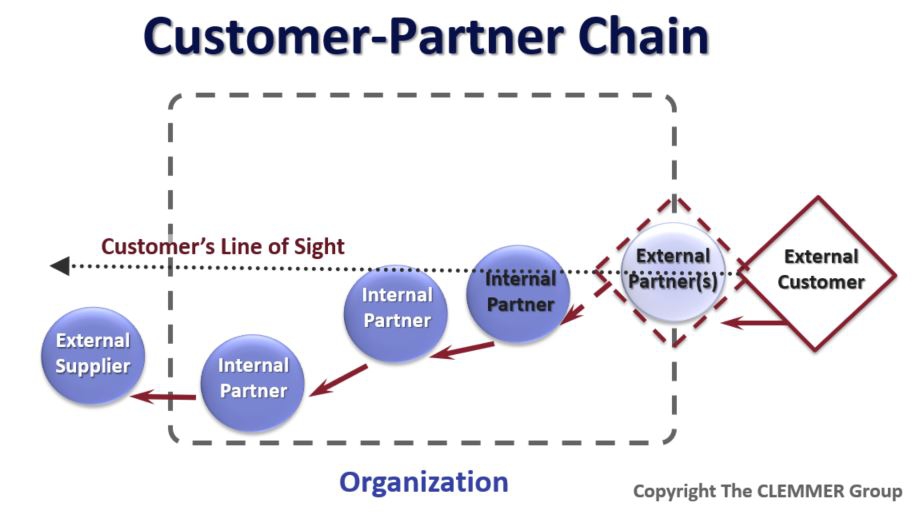
The Customer Service Chain is often a useful visual in building a culture of serving the servers to boost the customer experience and live up to the organization’s brand promise. Its core message is “if you’re not serving customers directly, you need to serve someone who is.”

Customer Partner Chain

7 Tips for Co-Creating a Higher Service Culture:

  1. Draw a customer-partner chain for your organization. Start with a key customer segment and work your way back through external partners and each team or department to external suppliers. Help everyone see where they fit in the big picture.
  2. Regularly bring the voice of the customer and actual customers into your organization. Take support staff who rarely deal with customers out to meet them.
  3. Update customer and internal partner performance data frequently (daily or weekly) and make visible to everyone.
  4. Work with servers to systematically identify root causes of service problems and involve them in a continuous improvement process.
  5. Post service trend charts and customer experience/process maps for all servers to keep score and stay engaged in the improvement process.
  6. Continuously ask servers to identify and prioritize what’s getting in the way of higher service levels and involve them in addressing the issues.
  7. Make it easy and painless for internal partners to raise issues and concerns. Respond promptly and systematically to analyze the trends for improvements.

I often encounter caring servers who want to respond to my request or help me deal with a service problem. Many times, they’re as frustrated as I am with the situation and their inability to solve it. Too often I’ve heard some version of, “Please complete our survey or make a complaint about this. Nobody listens to me. Maybe they’ll do something about it if enough customers like you complain loud enough.”

Share

Mental Health Problems and the Workplace

October is Mental Health Month. Recently there has been bigger mindfulness of the impact of mental health problems on individuals and the workplace. The economic impact is realized through direct treatment costs to the health care system as well as indirect costs, such as reduced or lost productivity due to absenteeism.

Mental health problems account for about half of employee absences due to illness each year in Canada for example, 3.5 days lost per employee per year are due to mental health problems. It is estimated that mental illness results in 35 million lost workdays each year in Canada.’

Employees living with mental health problems may feel and behave out of character at home and work. There may be feelings of things not quite right, yet they are unable to pinpoint the problem. Their co-workers, supervisors and family members may start to notice a change in mood and behaviour.


 Signs that indicate an employee or colleague may have a mental health problem are:

·      Regular late arrivals or often absent

·      Lack of teamwork or an over-all disinterest in working with co-workers

·      Lower output

·      Increased mishaps or safety problems

·      Numerous complaints of exhaustion or unexplained pains

·      Difficulty focusing, not being decisive or forgetting things

·      Making apologies for missed deadlines or poor work

·      Decreased attention or involvement in one’s work

·      Working excessive overtime over a prolonged period

·      Expressions of outlandish or grand ideas

·      Displays of irritation or pointing the finger at others


It is important to highlight that people behaving in these ways may be just having a bad day or week or dealing with a difficult situation in their personal life that may be temporary. A pattern that continues for a more extended period, however, may point to an underlying mental health problem.


Stress is a consistent part of life and work, and it can be positive or negative. Unwarranted hurtful stress through life events, including workplace issues, can contribute to mental health problems. Work itself can be expected to generate a certain level of stress associated with meeting deadlines and expectations, the need to feel valued and the loss of control over one’s time.


There are many causes of workplace stress. One key to effective stress management is maintaining awareness of the potential stressors and readiness to address them before they become problematic. Some of the most critical sources of work-related stress are listed below.

·    Poor communication

·    Incongruity in work demands, individual ability and amount of control over working practices

·    Work overload and work underload

·    Shift work and/or night work

·    Segregation, isolation and/or unstructured support for home workers

·    Short-term contracts

·    Role conflict, uncertainty and changing roles

·    The uneven weight assigned by management to consultation, support and control

·    Lack of training for managers in communication and people skills

·    Idleness

·    Uncomfortable physical workspace

·    Introduction of new technology, if not planned and gradual

·    The culture of presenteeism, in which an employee feels the need to be seen working at all times

·    Work-life imbalance

·    Home-based stresses that support or feed off of work-based stresses


Managing workplace stress can include training for employees to raise awareness about the causes and effects of stress, as well as to learn skills for coping with stress at work and in their personal lives.


Research has shown that some job stressors are worse than others, such as jobs that continuously involve imposed deadlines over an extended period and give individuals little control over the day-to-day organization of their work (high demand/low control). These jobs can lead to more than double the rate of heart and cardiovascular problems. As well as significantly higher rates of anxiety, depression and fell of being undermined. High demand/low control jobs also lead to substantially higher alcohol, prescription and over-the-counter drug use, and a significantly higher susceptibility to infectious diseases.’


Jobs that require high physical or mental effort but offer little in the way of compensation, status, financial gain or career enhancement (high effort/low reward) also affect employee stress levels. These jobs are associated with triple the rate of cardiovascular problems and significantly higher rates of depression, anxiety and conflict-related problems


The health of workers does not have to be compromised by stress. Changes to the workplace can make for a more mentally healthy workplace, especially when employees feel adequately rewarded and have greater control of their work.


Mental health problems can seriously affect someone’s ability to work. If left untreated and the mental health problem worsens, the employee may need to stop working altogether.


On the other hand, employees may try to continue to work knowing that they are not performing to their usual standards. If mental health problems are acknowledged early, and proper treatment is obtained, most people can quickly return to their regular performance at work, and much unhappiness and suffering can be avoided.


Monika B. Jensen Ph.D
TEL: 905-683-9953

WEBSITE: www.aviarygroup.ca
PRINCIPAL
FAX: 905-683-9912


Share

The answers municipal governments have been looking for?

Municipal governments are facing multiple, growing, and overlapping challenges. Yet, there are tools available to address these challenges that are not being used to their full potential. Market-based policies such as well-designed user fees can help reduce traffic, cut water use, and improve solid waste management, while generating revenue that can be used to fill financial gaps.

These challenges include:

  • Municipal infrastructure is aging and faces a growing investment gap;
  • Municipalities have limited ability to raise revenues. Only so much can be raised from property taxes. They also often face constraints on debt financing; and
  • To attract people and investment, livability is key: cities must provide job and recreational opportunities, ensure affordability, make it easy to move people and products, and protect clean air and water.

Continue reading

Share

Top 4 Considerations to Save Money When Improving Citizen Services

By checking your own internal bias you stand a better chance of Finding the best solution

We all want to better our citizens’ services but, when pursuing this goal, what can we do to ensure we are spending the right amount of money on the right plan?  The only way is to look at your citizens, your goals and what you currently have to achieve the right balance between spend and results.

Here are four areas you should consider to make sure you are getting the most for your money.

1.       Understand first. 

·         When creating any plan, the first action should be to understand the needs and wants of your target.  Not all people will have the same issues as you. The only way to know is to ask your citizens, listen intently and believe them. This is particularly true when you think you have solved certain issues already.

·         In modern agile technology development, the practice is to rely on the” voice of the customer”. This is to ensure when the product is complete it meets the needs expressed by the potential buyer.  The same is true in finding the best solution for your citizens.

·         Remind yourself that you are not the citizen. Assume that you do not really know anything about your citizens’ needs. This way you will not try to prove your bias right or dismiss some expressed citizen needs as “not important” or “already solved”.

2.       Look at what you have today.

·         Look at the processes you have today that are at the heart of any of the issues identified by your citizens (e.g. a citizen is not notified when an issue is fixed – perhaps because a work order is lost after a job is completed so there is no record of it being closed).  Ask yourself what vehicles, tools, and processes you are using to meet your “citizen service goals”.

·         Are you using your website to get information out?  Do you have posters in community gathering spaces? Do you have a section every week in the local paper? Do you have a CiRM or a spreadsheet to track issues?  Do you have a written policy that helps all staff to address citizen issues quickly?  Do any of these create or solve the issue expressed by your citizens? These types of questions are key to success.


3.       List all potential solutions.

·         Improving citizen services may not require buying new hardware or software and spending a bundle on installation and configuration.  A successful solution, regardless of how great it is, may very well need to be coupled with bettering an internal process. Or maybe it is a simple matter of increasing the awareness of your website or creating posters to inform citizens about how you do things and why.  It might also be possible to improve services by repurposing technologies that you already have in hand (e.g. using your CRM in a unique way or changing access permissions so more people can answer the questions posed by citizens).

·         Listing solutions should not be an excuse to try to make current software do things it was not meant to do. Look at the process you want to have first then find the solution that best fits it.

·         Do not be afraid to look at human resource factors.  Maybe the answer is to better train staff in citizen resolution or conflict management (customer service skills). Maybe you need to ensure that all staff members know your policies and how they should be implemented.

4.       Consider technology solutions by task, not product name.

·         List your “service goals” and rate the importance of each of one. The best way is to break down your list into the following columns: “must have”, “good to have” and “nice to have”.

·         If you think that technology might solve some of the issues, list only the “service goals” you want your software to address, i.e. not what features or what brand will be the best solution.

·         Remember the technology may not need to be citizen facing to increase satisfaction. It might just enable an improvement in your processes to offer better, faster and more reliable citizen services.

If you consider these four areas, you will likely find a solution with that best fits your budget, and that will have the largest impact on your citizens.  By checking your own internal bias, you stand a better chance of making sure the right process, tracking and communication methods (internal or external) are part of your change, and the costs may well be less than you thought.

At AccessE11 we understand that paper systems and endless email chains are not productive when it comes to citizen services and support. There are too many opportunities for an issue to fall through the cracks, or for delays in responses to issues.

We promote instilling processes that make sense and that are easy to adopt so that everyone in the municipality can become a citizen support expert.  Please visit us at www.accesse11.com to find out more.

Share

Small to mid-sized municipal guide to digital government and citizen satisfaction

by: Brad Pinch Director Of Municipal Needs – AccessE11

Citizen Relationship

In small municipalities, we hear a lot about digital government and citizen experiences. We often think this is a question whose answer is just to buy the latest software and hardware.

A  recent study done by PWC has once again re-enforced the principle that digital service channels improve the overall satisfaction of citizens. I don’t think that is surprising to most of us. However, before we all run out and start spending thousands of dollars building state-of-the-art citizen applications, e-commerce solutions or internal databases with portals for citizens, we should first ensure we understand why citizens are more satisfied when they have access to digital service channels. To do that we need to understand the specific problems faced by citizens that lead to a sense of dissatisfaction. Is a citizen facing technology sufficient to address their issues?

The studies of citizens (customers) indicate satisfaction is a product of actions that are evaluated on an emotional level.

Here is a brief summary of emotional needs that affect citizen satisfaction.

  1. Empowerment – The citizen needs to feel that every part of an interaction is centered on them (customer-centric services). This speaks to our ability to provide fast/timely services, setting realistic expectations and providing a defined structure that any interaction will follow to ensure a timely and appropriate outcome.
  2. Personalization–  Citizen’s should not perceive that they are being provided a “one-size-fits-all” approach to their interaction. Any process needs to adapt to the individual and their specific circumstances. This is achieved by providing different resolution paths, empowering staff to solve simple issues on their own (one and done) and providing choices which can make the system feel more tailored. The result is a citizen who feels valued as an individual.
  3. Multi-channel experience– Citizens want to engage with any staff or any department using the method of communication they desire regardless of the request. By funneling all inputs into a centralized system (one that all staff can see) via multichannel options (phone, voice mail, walk-in email, and web) staff and departments can ensure there are “no wrong doors” when it comes to logging or looking for solutions. This way you remove the need for the citizen to navigate your organization to get help.
  4. Transparency– We often talk about transparency in government with regard to visibility into how tax dollars are (or will be) spent. However, for citizens, transparency must also include access to information on their specific issues, timely updates on activities that impact their individual concerns, a clear and consistent understanding of the processes and policies that apply, and being able to obtain the information they desire without needing to make a complicated request.

Citizens of smaller municipalities have the same service expectations that are available to those living in larger cities.  With the right set of tools and best practices, this can often be achieved with a budget and staffing levels consistent with smaller organizational resources.  By keeping things simple and focusing on the unique needs of your citizens, delivering on high service levels does not need to cost a lot.

For More Articles of interest for Municipalities please visit Insight E11 at AccessE11.com

Share

Legacy Systems; The Old Rebuild or Reuse Software Conundrum

Why the Rebuild Route Makes Sense

Text image that reads Rebuild vs Reuse

Typically, in the short term, the rebuild will cost more, but over time, will cost less, provide better ROI and create potentially happier and more efficient employees.

We have created a handy ROI calculator that we use when discussing the true value of saving time and having more efficient workers. This calculator and the logic with it can be downloaded here: Software ROI Calculator.

Rebuild vs Reuse: Things to Think About

With any rebuild of a legacy solution the following areas must be addressed:

    • Mobility: Employees need to access data from different handheld devices. Be it iPhone, Android or Blackberry. Today technology exists to make a solution device agnostic.
    • Web (Remote) Access: Using a browser to access the data provides the most cost-efficient way for users to access data; whether it is internal users or external users. Mobile users can access the web browser to use, interact or access the new system.
    • Future-Proof Workflow: By rebuilding a solution, potential technology traps can be avoided. Ideally, any system built should scope out and last for 6 to 8 years before workflow modifications are required.
    • Collaboration: Gone are the days of a static web page. Companies, big and small, want some form of customer integration with their web page. Rebuilding a solution using a custom web technology will allow a web page to bolt on and be used by both employees, customers, and prospects.

Gone are the days of a static web page. Companies, big and small, want some form of customer integration with their web page. Rebuilding a solution using a custom web technology will allow a web page to bolt on and be used by both employees, customers, and prospects.

Whenever I visit a potential new customers site, I am always surprised by the age of some legacy systems. Moreover, I am surprised at how a great return on investment from the past has now turned into a system/process that is inefficient and a detrimental for employees.

If your existing system was built more than 15 years ago and is still working and being used – congratulations! You have certainly received a great ROI from past investments. But now might be the time to think about a rebuild of your solution. Rebuild before access, inefficiencies or age of hardware severely hurt your business’ growth.

Every business is unique and so is the software they need. Get your free Personal Needs Analysis today.

Share

Cyber threats and how to protect your municipality

Brad Pinch – Director of Municipal Needs at AccessE11


Often, when we hear about securing online systems against cyber-attacks the first thought is to invest time and energy into cybersecurity software. While this is important, and should not be downplayed, did you know that software alone will only defend against a small percentage of cyber-attacks?

Hacker Image


The easiest way for someone to breach your security infrastructure is to employ the unsuspecting assistance of your users.

According to PhishMe’s 2017 Enterprise Phishing Resiliency and Defense Report, 91% of all cyber-attacks are a result of people who fall prey to Phishing Attacks. Of the remaining 9% of cyber-attacks, more than 75% are the result of other forms of “human failure” to secure information.

Phishing is an attack that begins with a very targeted email sent to your staff (and perhaps yourself), that often impersonates a service provider, colleague, family member or friend and entices you to click on a link or open a document. This action may include a request for private information that provides the perpetrator with the means to launch a secondary cyber-attack or it may launch an attack directly through the download of malicious software. Attacks can be in the form of spyware, malware, and increasingly ransomware and data theft.

Wombats Security’s – State of the Phish 2018 report– suggests that phishing attack frequency from 2016 to 2017 increased by 48%; phishing is on the rise because it continues to work. Hackers have quickly learned that it requires less energy to trick users into giving them access than it does to circumnavigate the sophisticated security systems deployed today.

6 simple steps that a municipality can do to protect themselves

Here are a few steps a municipality can take to minimize its chances of security breaches and cyber attacks.

  1. Stay Informed and educate your team

Much of the battle against phishing and spear phishing (personalized phishing) attacks is getting users to understanding what this type of attack looks like, so they are less likely to be duped. Phishing relies on basic human conditions:

  1. information overload and shortcuts our brains take to process the information,
  2. a desire to help those we care for and trust of information that (seems to) come from them,
  3. curiosity for new information.

These traits are well known to attackers and are exploited in order to get victims to click on a link or open a document. Emails look like they’re from legitimate sources: Microsoft 365, Google, Dropbox, PayPal, Adobe account, LinkedIn, credit card company and many more.

There is a great infographic called don’t get hooked: how to recognize and avoid phishing attacks from the Digital Guardian. Print it out and post it for all to see.

  1. Keep your software up to date

Malware is being created all the time and is designed to take advantage of newly discovered vulnerabilities in our general use software. Vendors are quick to update their software, but you must update your version in order to be secure. You should regularly, or ideally automatically, update your software:

  1. Browsers (Chrome, Safari, Firefox, etc)
  2. Operating Systems (Windows, MacOS)
  3. Office Software (Outlook, Word, Adobe)
  1. Call before you click

Any email from a bank or colleague can usually be responded to directly, rather than via a reply or by clicking on a link. If there is ever any doubt, call your bank on the phone (using published numbers, not one in the email), or log directly into their website directly – not from the link in the email. By not taking the shortcut, fraudulent links can be avoided.

  1. Install anti-virus software and activate the Anti-Phishing toolbar if available

Antivirus software is designed to guard against known vulnerabilities. Even though today’s operating systems are more secure than ever, security tools look for malicious content in real time and provide an extra layer of scrutiny. And make sure you keep it updated as well.

Internet browsers can also be extended with anti-phishing toolbars. Such toolbars run quick checks on any site you visit and compare it a to lists of known phishing sites. If you stumble upon a malicious site, the toolbar will alert you about it. This is just one more layer of protection against phishing scams, and there are many that are completely free.

  1. Implement Secure Password Policies

As hard as it is to believe, the 10 most common passwords in 2017 were:

  • 123456, 123456789, qwerty, 12345678, 111111, 1234567890, 1234567, password123, 123123, 987654321

It won’t take a hacker long to break these codes.

Equally important though – do not use the same password for everything: If you do, and someone gets access to one system, they can often get access to them all. If you struggle to remember passwords (who doesn’t) there are many excellent tools that can assist:

These programs store an encrypted version of your passwords on your computer and conveniently provide them when you need them. This means remembering only one password.

  1. Beware the Unknown Storage Devices

It is possible the free USB drive that is received from a tradeshow, or the one you found in the parking lot has a virus on it. Sites that sell marketing USB drives unwittingly provide ones that have viruses installed from the source in China, Russia, India, Korea and other countries (yes including the UK, US, and Canada). These were likely never checked by the company who put their information on the drive to give to you.

If a data storage device is not bought by your company or municipality from a reputable source then it should not be allowed on one of your computers, ever!

These are only a few ideas to help better protect your organization from cyber-attacks. The common element in each remains the same; people and their behavior represent the greatest risk but also provide the best defense against cyber-attacks. Any user can open the door to intruders, so ensuring everyone understands the risk and remains vigilant is critical. Investment in the human factor will pay off quickly and be more cost-effective than any other action.

For More Interesting Articles on Issues that Municipalities are facing please visit us at https://www.accesse11.com

Share

Everything You Need to Know about Software ROI

While not all projects or organizations are alike, there are many different elements of technology acquisition that have different value propositions and hence, need to be evaluated differently.

Here’s everything you need to know about software ROI… Let’s get to it…

People at office laptops

Software Value Proposition

Software is unique – it can run on almost anything, comes on a disk, CD, DVD, download, Cloud… It can do almost anything – from organize your day, inventory, plant, office, people, customers… you get the idea – it is somewhat ubiquitous – because you can never use that work too much.

Software value proposition aligns directly with the big three ROI elements reviewed in my previous blog:

  • Increased Revenue/Gross Margin
  • Increased Bottom Line/Efficiency
  • Improved Customer Experience

But how do you measure these (without hiring a team of financial specialists and accountants)? Let’s get back to the KISS principle.

Some software has an acquisition cost in either license costs or development costs. This licensing model typically has some form of maintenance or upgrade cost associated – you may also want to incorporate some component for infrastructure costs. Subscription [OK I’ll use the Cloud word] based software has a monthly or annual fee. All of these models can fairly easily allow you to find a long term direct cost of ownership – I would suggest you span this out past 5 years for acquisition licensing model with a 10-year life span or 5 years for the subscription model.

You now have a handle on the long term investment in the solution – sadly that may be the easy part…

In order to measure the returns, it can get a little more complicated. Let’s look at the big 3.

1) Revenue/Gross Margin

If you can you attribute specific revenue increases to the functions the software provides, then it simplifies things. It may not always be so easy. New geographies, increased penetration into existing accounts, cross selling metrics can be functions of many things. Additional revenue from online transactions is easier to quantify. Ultimately, it will be important to quantify these to your best ability. If you can attribute the reduction in direct Cost of Goods to the revenue, this number becomes somewhat obvious.

2) Increased Bottom Line

Generally, this is one of the somewhat easier parts to quantify – If you are in a position where you need to hire additional resources to complete tasks that automation can address, you can offset these net costs directly. Ultimately if you have operational costs that are labour intensive, eliminating the inefficiencies of these tasks through automation will reduce costs through increased production without increased labour and deliver an improved bottom line.

3) Improved Customer Experience

In a world where customers will pay for a premier experience, this may be one of the most important aspects of ROI, but perhaps one of the hardest to quantify. Through an improved experience, your “customers:”

  • Have a higher degree of loyalty
  • Purchase more from you because you are always open or have tools to purchase when they need it (impulse)
  • Have access to information to do their jobs from anywhere without interrupting their jobs
  • Rely on your organization because you are an extension of them

Ultimately the goal here is to attempt to quantify (in real dollars) the gains from these activities.

The rest is just math…

Person typing on a keyboard

A Simple Approach to Calculating ROI/ROI%

(Recognizing there are no factors for NPV for the financially oriented readers)

Calculate all direct costs for the useful life of a project (Development, Licensing, Support):

  • e.g. $ 50k initial development + 5k support annually for 10 years = 100k direct costs

Calculate the increased bottom line contribution through increased revenue, decreased cost:

  • e.g. Reduce hiring requirement of a $60k person, increase revenue by $ 50k annually through efficiencies = ($ 60k + $50k) * 10 = $ 1,100k
  • ROI (months) = 100k/1,100k*120 = 11 Months
  • ROI% = 1,100/100*100 = 1,100% or 110% annually

Chat with CoreSolutions about Delivering Tangible Results

Our rule of thumb for the viability of a project is fairly simple. When you invest in a project, the project should pay for itself within 18-36 months through increased returns. After that period you will receive these increased financial returns for the balance of the software’s useful life. Typically, this results in a 40-80% annualized ROI% – very few financial investments can boast these levels of return.

I would welcome the opportunity to chat with you about how we might assist in optimizing and growing your business and delivering tangible results. So, connect with us via telephone at 1-800-650-8882 or fill out a contact us form on our website.

Share