You Can’t Build a Team or Organization Different from You

We can’t build a team or organization that’s different from us. Successful team or organization leadership begins with successful self-leadership. The first step in improving my team or organization is improving me.

 “The management of self is critical. Without it, leaders may do more harm than good. Like incompetent physicians, incompetent managers make people sicker and less vital.

— Warren Bennis and Burt Nanus, Leaders (in a chapter entitled “Leading Others, Managing Yourself”)

Too many managers who aspire to lead and develop others haven’t learned how to lead and develop themselves. They are trying to build organizations or provide services that are different than they are. These well-intentioned managers are trying to improve their teams or organizations without improving themselves. Many seem to be living along the lines of Mark Twain’s observation, “Nothing so needs reforming as other people’s habits.”

Here are some examples of these all too common disconnects between organization and personal performance:

  • Pessimistic managers push their companies to be market and industry leaders while blaming external factors like the economy for their poor performance.
  • Managers with stunted personal growth set strategies to build a “Learning Organization.”
  • Managers produce team and organization vision, values, and mission statements without having clarified and aligned their own personal preferred future,      principles, and purpose.
  • A major program to improve customer service is initiated by managers who boss, direct, and control rather than serve their organization’s servers.
  • Managers with weak levels of continuous personal improvement implement change and improvement programs — for others.
  • Strict Techno managers (bureaucratic or technical experts) oversee rigid systems and processes while trying to encourage risk taking and innovation.
  • Management groups comprised of turf protecting departmental managers, fighting like three kids in the back seat on a long hot drive, try to get others to build stronger teams.
  • Disorganized managers with poor time management habits are setting goals, priorities, and disciplined processes for everyone else.
  • Although they have no personal improvement plan, process, or habits, managers develop extensive organization transformation and improvement plans.
  • While avoiding (and shooting messengers of) personal feedback, managers construct extensive performance appraisal systems and talk about the importance of accountability — for everyone else.


A Team or Organization Can’t Rise Above the Level of Its Leadership

Organizational change begins with leaders who walk the talk by transforming themselves.

— Stratford Sherman, “Leaders Learn to Heed the Voice Within”, Fortune

It just doesn’t work. We can’t build a team or organization that’s different from us. We can’t make them into something we’re not. But I’ve watched countless managers and management teams try. There are two major reasons that this disconnected approach doesn’t work. First, unless you’re a superb actor, you can’t be a split personality and teach or lead others to do something that’s out of basic alignment with your own habits, skills, and characteristics.

Second, everyone’s “phoniness radar” or “BS meters” are getting ever more sensitive (from overuse). We’re getting fed up with sanctimonious church leaders charged with sexual abuse, fat doctors telling us to get into shape, politicians giving retractable promises to get elected, executives drawing big salaries and bonuses while their company’s financial value declines, municipal transit managers who don’t take their own buses to work, training and consulting companies who don’t practice what they teach, and the like.

I once wrote a scathing note (which was never answered) and quit a speakers’ association because I kept hearing “the old pros” telling people who wanted to get on speaking platforms and tell others how to be successful to “fake ’til you make it.” (The personal and organization improvement field has its share of aspiring speakers and consultants who don’t practice what they preach). One of those speakers also asked me to provide a jacket quote endorsement for a “motivational book” he bragged he’d written “on a six hour airplane flight.” And that’s about how much research and thought the warmed-over platitudes, old jokes, and generalities he’d pieced together obviously had. I declined his invitation.

We loathe phoniness and crave genuineness in our leaders. If I aspire to be a leader, the authenticity (being the real thing) that stems from aligning who I am with where I am trying to take my team or organization will inspire trust, cooperation, and forgiveness in the people who’ll help take me there. Nobody expects us to be the perfect role model. But they do expect to see a close connection between who we are and the direction we’re pointing the team or organization toward.

Or they at least need to see that we recognize our shortcomings and we are working hard to improve ourselves so we can close the organization-personal performance gap. Otherwise they’ll shrug off all our team and organization improvement rhetoric and planning with a sense that this is just Kidney Stone Management — it will hurt for awhile, but this too shall pass. “Watch out, he/she has been off to another seminar (or read another book). If we lay low long enough, he/she will move on to the next fad”.

Successful team or organization leadership begins with successful self-leadership. The first step in improving my team or organization is improving me.

Reprinted with the permission of Jim Clemmer. For over three decades Jim Clemmer’s keynote presentations, workshops, and management team retreats, and seven best-selling books translated into many languages, articles, blog, and newsletters have helped hundreds of thousands of people worldwide. The CLEMMER Group is Zenger Folkman’s Canadian Strategic Partner, an award-winning firm best known for its unique evidence-driven, strengths-based system for developing extraordinary leaders and demonstrating the performance impact they have on organizations.

http://www.clemmergroup.com


Share

Traditional versus Strengths-Based 360 Assessments

Joe Folkman is a global expert in psychometrics or measuring psychological factors. He wrote his PhD dissertation on data he collected from 360 assessments. Over the decades he’s developed feedback and measurement tools around a growing database now compromised of over a half million assessments on almost 50,000 leaders. Long-time feedback, executive coaching, and leadership development clients include AT&T, General Motors, Boeing, ConocoPhillips, CIBC, General Mills, Wells Fargo, and many others.

Recently I asked him to reflect on what he sees as the biggest difference between traditional 360 assessments (where he began his career) and the strengths-based 360 he developed and has used for the past 14 years:

  1. Traditional 360 has a very powerful message — focus on weakness — identify problems — find the losers.  Introducing a 360 process and letting people know we’re looking for strength takes the threat out of the process. The surprising thing is that those with fatal flaws are much more willing to acknowledge that they have a fatal flaw because we framed the conversation around strengths.
  2. Traditional 360 assessments typically ask “what does this person do well?” and “what areas could this person improve?” The list of improvement areas is long and compelling. Weaknesses are huge distractions. Even the best leaders have weaknesses. Great leaders are not perfect. The process of working on weaknesses encourages people to work on the wrong issues. Instead leaders need to know how others perceive their strengths and align those with “what does the organization need you to do to be successful?” and “what are you passionate about?” These questions identify the most powerful things for leaders to focus on.
  3. The Gestalt or overall feeling that is created by weakness-based 360 surveys is, “what is wrong” while the gestalt of the strengths-based approach is “what is right.” Weakness-based approaches equates with failure, faults, problems and pessimism. Strengths-based equates with success, strengths, what is right, and optimism.  The body of research on how optimists are happier, more effective, and stronger leaders is compelling.
  4. Basically organizations are successful because of how they stand out, what differentiates them, basically their strengths. They are not perfect. Organizations fail because they do something terribly wrong. People are the same.

If you’d like to explore the compelling research behind Joe’s reflections see Focusing on Strengths or 360 Assessments.

Reprinted with the permission of Jim Clemmer. For over three decades Jim Clemmer’s keynote presentations, workshops, and management team retreats, and seven best-selling books translated into many languages, articles, blog, and newsletters have helped hundreds of thousands of people worldwide. The CLEMMER Group is Zenger Folkman’s Canadian Strategic Partner, an award-winning firm best known for its unique evidence-driven, strengths-based system for developing extraordinary leaders and demonstrating the performance impact they have on organizations. http://www.clemmergroup.com

Share

Changing Workplaces Review – Interim Report Issued

Changing Workplaces Review – Interim Report Issued

July 27, 2016 By: Paul E. Broad, Craig S. Rix

FTR Now

Changing Workplaces Review – Interim Report Issued

Date: July 27, 2016

Since May 2015, two government-appointed Special Advisors – Mr. Justice John Murray and Mr. Michael Mitchell – have been undertaking the Changing Workplaces Review (Review) to consider the changing nature of the workplace, the causes behind those changes, and whether the Labour Relations Act, 1995 (LRA) and the Employment Standards Act, 2000 (ESA) need to be amended to meet challenges created by the changes.

As reported in our FTR Now of May 15, 2015, Ontario Begins Consultations on Labour and Employment Reform, the Special Advisors were tasked with considering non-standard working relationships, the expanding service sector, globalization and trade liberalization, technological change and workplace diversity.

Earlier today, the Special Advisors released their long-awaited Interim Report. In this FTR Now we discuss some key issues identified by the Special Advisors. We will be providing further updates on the Interim Report by next week.

The Interim Report is a wide-ranging document, over 300 pages in length. After reiterating the context of the Review mandate, the Special Advisors emphasize that their recommendations will focus primarily on vulnerable workers engaged in precarious employment. The Interim Report does not generally identify specific recommendations. Rather, it serves several purposes:

  • identify the substantive areas of the LRA and ESA that are being considered as part of the Review;
  • outline the current state of the law and employee entitlements in each of those areas, drawing on context from other jurisdictions within Canada, as well as differing approaches in foreign jurisdictions, including the United States, the European Union and Australia;
  • summarize the submissions made to the Special Advisors, identifying areas where submissions may have been lacking;
  • identify the key options for recommendations that the Special Advisors are considering; and
  • seek further input on those key options.

The range of options being considered by the Special Advisors is very broad and potentially far-reaching.

Labour Relations Act, 1995

A wide range of options are canvassed that have the potential to fundamentally alter the current labour relations landscape.

One option canvassed is a return to a card-based certification process. This would mean the end to the current fast vote, secret ballot process (in all sectors save for the construction sector) and the return to a process that hasn’t existed in Ontario since 1995. Under a card-based certification process, an employer could find itself unionized if a defined percentage of employees in the union’s proposed bargaining unit signed a membership card.

Beyond the Interim Report’s analysis of the certification process, many other options are explored that were once a part of Ontario’s labour relations laws in the 70s and 80s:

  • requiring employers to provide an organizing union with a list of their employees before an application for certification is filed thus enabling the union’s organizing efforts;
  • expanding the basis upon which the Ontario Labour Relations Board could issue a penalty certification in the event of a breach of the LRA during a union organizing campaign;
  • reintroducing the Bob Rae government’s Bill 40 notion of automatic first contract interest arbitration; and
  • prohibiting an employer’s current ability to utilize replacement workers in the face of a strike.

Employment Standards Act, 2000

With respect to the ESA, the Special Advisors are considering options related not only to the substantive employment standards, but also the ESA’s scope of application and how it is enforced. Some key issues identified by the Special Advisors include:

  • whether the ESA should be extended to independent contractors and dependent contractors;
  • an expanded scope of who is an employer – for example, making franchisors liable for ESA violations of their franchisees, or implementing an expanded joint employer test;
  • a recommendation to review the ESA’s various exemptions, with an anticipated recommendation that certain hours of work and overtime exemptions be narrowed or eliminated (e.g. IT professionals, and managers and supervisors);
  • whether changes should be made to the ESA’s leave provisions, with a special focus on Personal Emergency Leave, and whether there should be an introduction of paid sick days; and
  • further amendments to the regulation of Temporary Help Agencies, including potential restrictions on the use of assignment employees and potential increased entitlements for assignment employees.

Next Steps

As noted above, one of the purposes of the Interim Report is to solicit further input on the key options identified by the Special Advisors before a final decision is reached on the recommendations. The government has announced two (2) separate timelines for making submissions:

  • August 31, 2016 for submissions on the Personal Emergency Leave options canvassed in the Interim Report; and
  • October 14, 2016 for submissions on all other options on all other topics canvassed in the Interim Report.

We are in the process of reviewing the Interim Report in detail, and will be providing further updates by next week, including how submissions may be made to the Special Advisors. In the meantime, if you have any questions related to the Interim Report, please contact your regular Hicks Morley lawyer.

Published with permission of and Thanks to Hicks Morley.

Share

Reactionary vs Strategic Leadership Development

Your problem is not your problem, your problem is a culture that creates your problem.

I often get calls from potential clients to conduct a workshop on a particular topic to address a problem or issue they are presently dealing with. I call this reactionary development rather than strategic development. This happens when organizations react to a problem by looking for a one or two day training solution to fix it. As much as I like to work I always tell them the same thing, “there is no magic bullet workshop that is going to fix the problem, it takes a long-term strategic process in most cases.” The root of most issues is an unhealthy culture and ill-equipped leadership. To fix the problem, focus on the culture, and culture change takes time, a minimum of three years.

Why is this? Because most problems being dealt with in the majority of organizations are related to the lack of competent managers and intentional culture development. Just because someone is really good at their job, which is why they get the promotion, doesn’t mean they will make a great manager. People are promoted into management positions because of their superior technical skills and often demoted or fired because of their lack of interpersonal and emotional intelligence skills. Most organizations promote people to their level of incompetence then leave them there or get rid of them.

Gallop just released research indicating 80% of people in management positions are not prepared to be there. The time to prepare for the issues any organization will face is before they happen. There are key competencies that every manager needs in order to provide effective leadership, improve engagement, performance and create an engaging culture.

C.O.R.E. Leadership Academy 

C.O.R.E. Leadership Academy provides a long-term strategy with quarterly training opportunities focused on developing competent managers and supervisors and creating healthy cultures.

Why quarterly training? It takes approx. 66 days to form new habits, and research confirms learning is more effective when people focus on one topic or skill at a time. For that reason C.O.R.E.  Leadership Academy (CLA) provides quarterly training opportunities using 70-20-10 personal development process to apply what is learned. By providing quarterly development opportunities specific skills are built upon each quarter, or a theme can be the focus for an entire year.

C.O.R.E. – Of central importance; the basic and most important or essential part of anything

CLA Philosophy – focusing on key strengths leaders, managers and supervisors need to become competent provides the greatest potential for personal and organizational success.

CLA’s primary focus is the development of…

C – Competent Managers

O – Organizational Culture

R – Relationship Management

E – Efficient Workforce Strategies

For a free consultation on bringing CLA to your organization email [email protected] or call (705) 607-1058

Share

Enabling Millennials in Government

Public administrators face two imminent threats to their workforce: experienced Baby Boomer executives and staff are retiring, and their departments lack a deep bench of workers to fill the rapidly emerging vacancies.

We found this topic particularly interesting because it’s for these very same reasons muniSERV partnered with the Ontario Municipal Administrators Association (OMAA) to develop our new CAO Job Seeker database. 

Thanks to OpenGov for providing this complimentary e-book. You may need to sign up to download it but it’s worth the read and provides 4 strategies for developing the next generation of municipal leaders.  Administrators-Primer-Enabling-Millennials-in-Government-WP

Share

Partnership Brings Free Ontario Traffic Manual Training to Ontario Municipalities

Frank Cowan logoFrank Cowan Company, in partnership with Ontario Good Roads (OGRA) and the Association of Ontario Road Supervisors (AORS), will provide Ontario municipalities with free technical training on Ontario Traffic (OTM) – Book 6.

“We see numerous claims alleging non-conformance with the OTM, such as improper signage, lack of pavement markings and poorly placed chevrons”, says Barb Szychta, VP, Risk Management Services at Frank Cowan Company. “We decided to take the lead and help municipalities close off a litigation avenue by providing a series of training workshops”.

The sessions will educate participants on the various types of claims that are being reported, the principles of positive guidance, the types of hazards requiring road signs and the principles that must be followed when placing a chevron alignment sign. Municipalities with predominately rural roads and/or a rural/urban mix will benefit the most.

“Correct signage and monitoring to ensure we are meeting our MMS obligations is a related essential component of road safety”, says Robert Burlie, President of Ontario Good Roads Association. “OGRA is pleased to partner with Frank Cowan Company in bringing this important training initiative to municipalities, and we hope many of our members will take advantage of this unique opportunity to enhance their knowledge of the Ontario Traffic Manual.”

Greg Demers, CRS-I, AORS President says, “To keep roads in a state of repair is not just limited to providing a safe driving surface. The duty of care for Municipalities extends to the road design which includes pavement markings & placement of correct signage to provide positive guidance for drivers. AORS has partnered with OGRA and Frank Cowan Company to provide a series of essential Ontario Traffic Manual/OTM (Book 6; Warning Signs) training courses for Ontario public works personnel.”

About Frank Cowan Company

Frank Cowan Company is a Canadian leader in providing specialized insurance programs, including risk management and claims services for municipalities and public service, healthcare, education, community, children’s and social service organizations across Canada. Proven industry knowledge, gained through 87 years of partnering with insurance companies and independent brokers, gives Frank Cowan Company the ability to effectively manage the necessary risk, advisory and claims services for both standard and complex issues. Frank Cowan Company’s head office is located in Princeton, Ontario with a branch office in Cambridge, Ontario. Clients and broker partners receive support out of both locations. For additional information about Frank Cowan Company visit www.frankcowan.com.

For more information :

Organization: Frank Cowan Company www.frankcowan.com Contact: Caryn McLean Manager, Marketing and Communications Tel: 1-800-265-4000 ext. 55344 E-mail: [email protected]

Share

Ontario’s New Sexual Violence & Harassment Action Plan – Is Your Organization Prepared?

IMG_0803

HRSP logo“ANY TIME THAT A SEXUAL HARASSMENT COMPLAINT COMES UP, IT HAS TO BE TAKEN SERIOUSLY. IF IT’S NOT ADDRESSED IN AN APPROPRIATE WAY, AN EMPLOYER COULD FIND THEMSELVES LIABLE FOR SIGNIFICANT DAMAGES.” – CRAIG STEHR, NELLIGAN O’BRIEN PAYNE LLP
On March 9, 2016, the Ontario government’s new Sexual Violence and Harassment Action Plan Act (“Bill 132”) passed Royal Assent and became law. Bill 132 amends the Occupational Health and Safety Act and requires employers to create, or revisit their Harassment/Workplace Violence Policy and program.

The Bill provides for an expanded definition of Workplace Harassment, first introduced in 2009 with Bill 168 (Violence/Harassment in the Workplace). With recent judgments of $150,000 and $300,000, being awarded for two different workplace sexual harassment/assault cases, employers can no longer afford to ignore this legislation and must ensure their policies/practices correctly reflect what is required.

Some of the main impacts to Employers are:

  1. A new statutory duty for employers to investigate “incidents and complaints” of workplace sexual harassment, so an employer is required to investigate even if there is not a formal complaint made.
  2. A Ministry of Labour inspector can order an employer to conduct an investigation by a third party, if there is an incident and the employer fails to investigate, or if it’s determined that the investigation was biased, failed to include the necessary parties, or was otherwise flawed.
  3. Under the new legislation, both parties must be informed in writing of the investigation results and of any corrective action, even though employers are not currently required to prepare written reports, or inform anyone of the investigation results.

Employers must ensure that:

  • They have a Workplace Violence & Harassment Policy and Program in place (That reflects the new wording), which includes wording on workplace investigations that complies with Bill 132
  • They have trained all their employees on these policies and programs
  • This policy is reviewed annually (For employers with 6 of more employees)
  • Someone has received training on investigating workplace harassment complaints; or should have access to an unbiased third party that can investigate complaints
  • They train all supervisors on workplace harassment so they can identify “incidents and complaints” of workplace harassment.

In addition, amendments made at Committee include:

  • The Ministry of Training, Colleges and Universities Act and the Private Career Colleges Act, 2005 will now permit the surveying of students/others on the school’s sexual violence policy. They will also require an annual report on the incidents/complaints of sexual violence made and the programs developed to promote awareness
  • A change in the definition of “sexual violence” applicable to community colleges, universities and private career colleges to include an act targeting a person’s gender identity or gender expression
  • A new requirement in the Occupational Health and Safety Act that an employer shall consult with the committee or a health and safety representative, to develop/maintain a written program to implement the workplace harassment policy
  • The Bill should be consulted for coming into force information. HRSP is experienced with policy development and training on this new legislation. If your organization needs help with implementing the requirements of #Bill132, please give us a call at 416-564-0174.

Andrea MacLean, CHRP is the Managing Director for HR Strategic Partners, an HR Outsourcing and Leadership Coaching company. You can follow HR Strategic Partners on Twitter at @HRSP_CA, or check out their website at www.hrstrategicpartners.ca.

Share

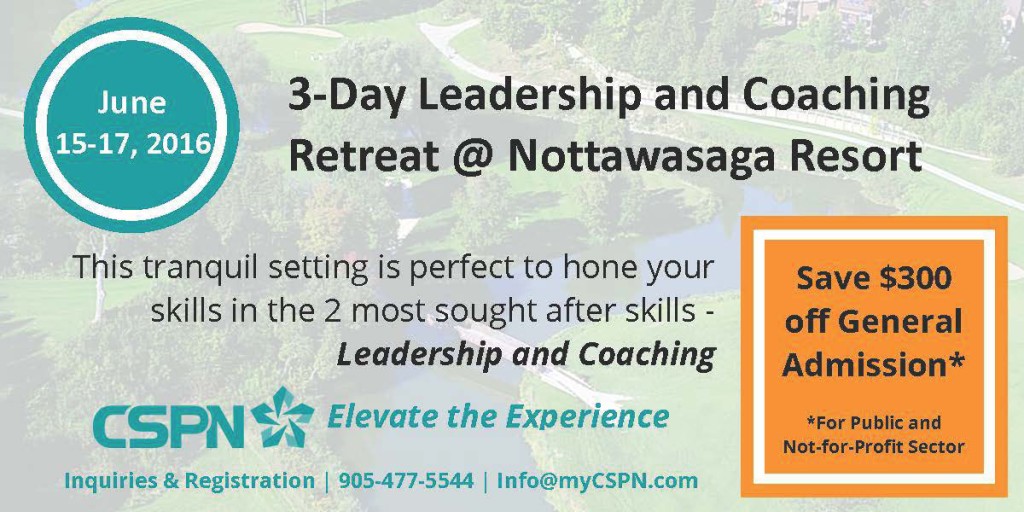
Don’t miss CSPN’s Leadership and Coaching Retreat

Don’t miss CSPN’s Leadership and Coaching Retreat – June 15-17, 2016

$300 Savings for Public and Not-for-Profit Sector

2016 Retreat - MuniSERV Apr Ad

Come mix business with pleasure in a picturesque setting and find the perfect balance of productivity and relaxation!

“Leading and Coaching with Impact” is an exclusive CSPN certification program designed to educate leaders who want to make a difference. Tailored for professionals required to lead and coach others, the “Leading and Coaching with Impact” accredited workshop helps shape individuals with the integrity and capacity needed to build effective and dynamic teams all while enjoying the relaxed and beautiful surroundings of Nottawasaga Inn.

Discover and Learn:

  • Lead others with or without authority
  • Coach others for peak performance
  • Learn the secrets of effective leadership
  • Deal with multiple generations
  • Put EQ to work for you


Space is limited – reserve your spot today! Learn more about CSPN and how to register.

Share

19th Annual Customer Service Conference May 11-13, 2016

30% Savings for Public and Not-For-Profit SectorCSPN Logo Full v1

Each year, Customer Service Professional’s Network (www.myCSPN.com) hosts a conference for customer service professionals.  Conference delegates include leaders from municipalities, various levels of government and corporations.  Join us to expand your knowledge in sessions presented by experts in the field, meet with exhibitors and to share stories on how to create a great customer experience.

The 2016 conference will be held at the Mississauga Convention Centre.

Cocktail Reception sponsored by Interactive Intelligence, May 12, at 5:00 pm

This year we have 25 dynamic speakers, including Michelle Musgrave, Director of Housing Operations with the Regional Municipality of York,  Jason Mclaughlin, Manager of Customer Interaction with Municipal Property Assessment Corporation (MPAC), and David Pitsch, Director of the Guest Education Centre with Lululemon Athletica.

In addition to our amazing lineup of speakers, May 11th boasts two contact centre tours – DHL Express Canada and The Shopping Channel. Join us as we interact with key personnel throughout the hosting contact centres and share best practices with peers. Space is limited – reserve your spot during registration!

Join us to learn more about:

  • Delivering the Brand Experience through your Employees
  • Moving from Transactional to Relational Environment
  • How to Motivate and Empower Employees to Deliver an Ultimate Customer Experience
  • Personal Effectiveness for Corporate Performance
  • The Challenge of Change
  • Separating yourself from the Competition by Increasing Employee Loyalty

This conference is sold out every year, so hurry and register for your 30% discount, because we do not want you to miss out.  We promise you will learn, discover, and glean new insights! 

The early bird registration deadline is March 7, 2016. 

For more information, please contact us; 905-477-5544 or [email protected]

Visit the Conference Website:  www.AmazeYourCustomer.com  

Share

Are you meeting your AODA Requirements?

Evac Chair pic

Attention Human Resources & Employers

EVAC+CHAIR has been around for more than 30 years and the Company expanded its operations into Canada in early 2014, to meet growing demand here. The company’s core client base is public sector facilities and healthcare but now with changing accessibility legislation across the country they have focused on private corporations and businesses. Jim Closs, managing partner, EVAC+CHAIR Canada, says the device has started to attract the attention of human resource directors as it answers the question of providing a safe workplace to all those in need as well along with those who may have entered their workplace with a disability.

The emergence of the untapped populous of persons with physical disabilities entering or re-entering the work force means that employers need to ensure their staff’s complete safety in the workplace including the ability to evacuate quickly.

EVAC+CHAIR is designed to help evacuate people with limited or impaired mobility when the stairs are the only way out of a building. The 20-pound tool, which has a capacity of 400 pounds, can be stored flat on the wall. When needed, users can dismount and unfold it in around 10 seconds.

The Industrial Designers Society of America has recognized the EVAC+CHAIR with a Design of the Decade Award. The tool has also been credited with saving lives in the evacuation of New York’s World Trade Center towers on 9/11.

EVAC+CHAIR bears a lifetime warranty and comes with a mounting wall bracket, vinyl dust cover, instructional DVD, full- colour user guide and patient restraints.

For more information, visit www.evac-chair.ca or email [email protected]

Share