Municipalities and the Use of Technology During the Pandemic

If our current situation due to COVID-19 has had any positive impact, it is that municipalities who have been hesitant to adopt technology are now realizing just how vital it is. In the past, many municipal employees were unable to work from home due to technology limitations and concerns about the protection of confidential information. Let’s take a look at how some municipalities are adapting to the “new normal”.


WASAGA BEACH, ONTARIO

While other municipalities have set up a system allowing many staff to work from home instead of reporting to town offices, in the case of Wasaga Beach, the risk of an information breach has prevented them from allowing staff to work off-site.

“We had a cyber-attack almost three years ago that has made us wary of the security of confidential information being transmitted over the Internet from off-site locations,” said Communications Officer Michael Gennings.

“We have implemented many of the measures that other municipalities have, including work shifts to increase physical distancing. Should the pandemic situation change, the municipality will consider its options at that time.”

“Staff that must stay home are required to use vacation time or explore a leave. The bulk of our workforce remains onsite. Some have taken leaves.”

Wasaga Beach council is meeting via video conference for regular meetings, and in council chambers for closed session meetings.


MEDICINE HAT, ALBERTA

The City of Medicine Hat has laid off 170 workers – about 15% of its workforce – and has deferred filling many summer positions as it wrestles with closures and budget stress related to the COVID-19 pandemic.

City Hall is attempting to conduct as much business as possible, but with less physical interaction and higher safety standards. “The City of Medicine Hat has taken the approach that it’s business as usual during an unusual time,” said Dennis Egert, the city’s corporate services commissioner,  pointing to online, teleconferencing, or directing resident queries via email rather than in-person meetings. 


NOVA SCOTIA

Despite the roadblocks presented by COVID-19, Nova Scotia’s municipal elections will go forward as scheduled. Electors from all 49 provincial municipalities will go to the polls on October 17 in accordance with the Municipal Elections Act stipulation that elections be held every four years on the third Saturday in October.

Chuck Porter, Minister of the province’s municipal affairs department, told reporters “At this point, we see no reason why municipal elections can’t move forward. We’re all adapting to do business differently these days and certainly we will work with (municipalities) to offer support where we can.

“We’ve done things in the past like electronic voting, by-phone voting in some circumstances. So I think there are a number of options that are out there for us to be able to vote this coming fall.”

How is your municipality dealing with social distancing, council meetings, and more? We would love to hear from you! Drop us a line and let us know how you are doing … [email protected]

Share

Pandemic/Epidemic Business toolKIT

We are deeply focused on keeping your employees, customers, and suppliers safe while working, visiting, or conducting business at your facilities and supporting your business operations.

The Michael White Group International and Hilt International Security have partnered together in order to create a dynamic resource that is continuously growing, developing, and being  revised to keep you informed of the latest requirements, new best practices, and procedures.

As we all continue to navigate our  ‘new normal’, we have tapped into our global resources to develop a toolKIT that lays out processes to raise awareness of new health and well-being protocols and potentially helpful practices for cross-functional teamwork, operating discipline, and training for employees.

While it is not a one-size-fits-all approach, the Pandemic/Epidemic Business toolKIT includes practical recommendations, based on guidelines from Health Canada and World Health Organization, that could be tailored for different  businesses (when required) to address various scenarios they may face when returning to work. Regular updates will be made to the toolKIT based on real-time feedback. The toolkit covers a wide range of topics, including:

•      Step-by-step guides for setting up a pandemic response team

•      Cleaning and disinfection procedures

•      Staggering shifts and lunch breaks and other physical distancing strategies

•      On-site health screening

•      Protocols for isolating employees who become ill at work

•      & more.

This has been a difficult time for everyone, and re-establishing a workplace where employees feel comfortable performing their jobs safely is a multi-faceted challenge. It is our hope that by developing and providing this resource we can help your organization accomplish and adapt to the new operating protocols in today’s still ever challenging conditions.

Should your Municipality be open to exploring the need, whilst accessing our  toolKIT to assist you during  the re-opening, and re-populating of your facilities, contact Michael White Group International today, and in partnership with Hilt International Security we will be happy to assist.


Share

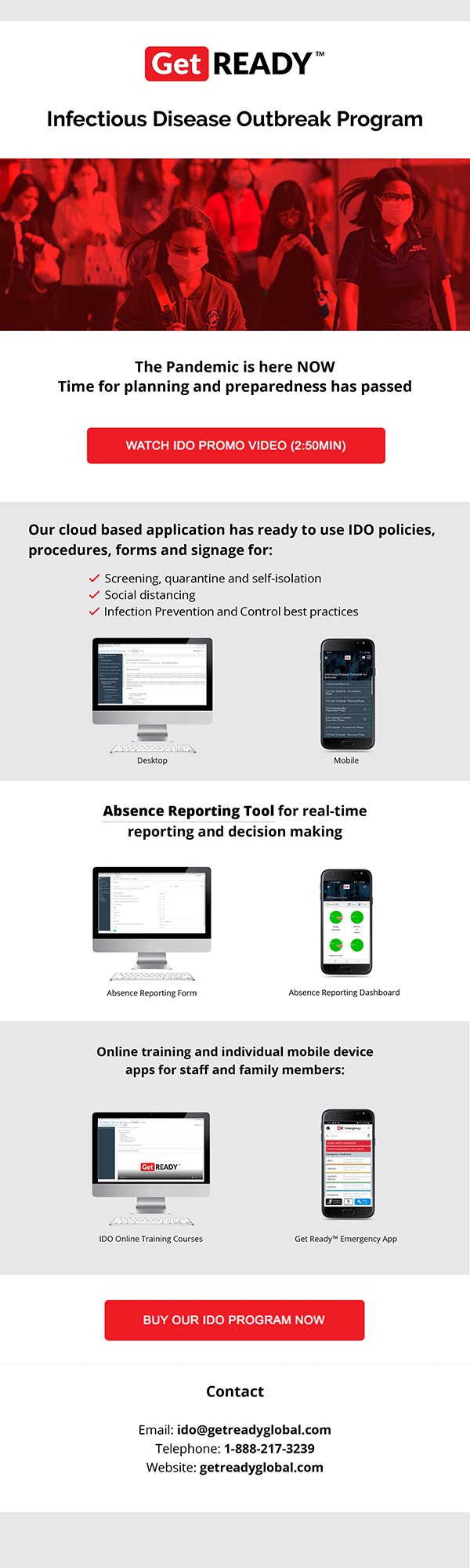
The pandemic is here. The luxury of time to plan has passed. We can help you stay operational…and stay safe.

The world is drastically changing and the Pandemic is now here. Municipalities no longer have the time to prepare. We are providing this information to help you Get Ready.

Get Ready is an Ontario-based company. Since 2011 we have been providing cloud-based Emergency Management, Business Continuity and Infectious Disease Outbreak programs to Municipalities, Healthcare and businesses across Canada.

Our Infectious Disease Outbreak Program has 4 main components:

  1. Cloud-based application with IDO best-practice policies, procedures, forms, signage, and communications
  2. Real-time Absence Reporting Tool
  3. Online employee Pandemic training
  4. Individual “Get Ready – Emergency” mobile App for all staff

Get Ready Programs meet CSA Z1600, Office of the Fire Marshal and Emergency Management, Ministry of Labour, PHAC and Health Canada standards.

Our cloud service maintains Federal government-protected B clearance, as well as, SOC2, ISO 27001, ISO 27017, ISO 27018 and PCI certifications.

The IDO Program is available for immediate deployment (onboarding takes 12-24 hours). The ROI is estimated to be 4 to 5 times the initial cost within two weeks of implementation.

Please contact us to learn how we can keep your staff healthy and safe and your municipality operating.

 [email protected]

1-888-217-2329

 https://getreadyglobal.com/programs-and-apps/infectious-disease-outbreak-program/

people with masks

Share

Is Your Municipality Ready for a Disruptive Event? Business Continuity Planning 101

Every municipality needs an Emergency Management Program.

There are a number of components that make up a comprehensive emergency management program, (i.e. Emergency Response Plan, Business Continuity Plan, Communications Plan, Employee & Family Support Plan, Pandemic Plan, etc.).

When I was with the Office of the Fire Marshal I was responsible for emergency management and the development of these plans for the OFM. And now in these times of global uncertainty, I am once again reminded of just how important it is for organizations to have them – and particularly a Business Continuity Plan (BCP) in place.

What is a BCP?

A BCP is a plan that outlines the critical services to be delivered during a disruptive event and how full operations are going to be resumed after the event.

A good rule of thumb to keep in mind is, your BCP needs to address planning/mitigation, response, recovery and restoration.

Generally, a Business Continuity Plan outlines:

  • Who is responsible for recovery actions

  • What is needed to deliver, resume, continue, or restore the municipality’s services

  • Where to go to resume operations if necessary, and,

  • How the municipality’s critical services and operations will continue to be provided during a disruptive event (detailed procedures for provision, recovery, resumption and restoration of services)

Basic Elements of a BCP

It is important to remember that while the unique characteristics of your municipality must be reflected in the plan, the basic elements detailed below represent the foundation on which every BCP should be built.

  • Gather the necessary Baseline Information – This is used to identify municipal services, where the service is located, who uses the service, dependencies, alternate service delivery, critical infrastructure, etc.

  • Conduct a Business Services Risk Assessment Needed to help identify areas of potential vulnerabilities and to examine current and necessary control measures to mitigate threats.

  • Undertake a Business Impact Analysis – Gathers information concerning the exposure and impact on the service should the service experience significant disruptions and assesses the potential financial and non-financial impacts of a disruptive event.

  • Develop a Business Continuity Recovery Strategy – Assesses the advantages and disadvantages, estimated associated costs and determines the recommended strategy for each critical service and the resources that may be necessary for quick recovery.

  • Identify Emergency Response and Operational Protocols & Procedures – This is a checklist of protocols and procedures that help to simplify the necessary activities even further (i.e. notification protocols, call trees, etc.).

  • Create the Business Continuity Plan

Of course, once it’s completed don’t let your BCP collect dust. Keep it dynamic by updating it to reflect any changes to personnel or processes, and practice it with your team so when a disruptive event occurs, like we’re experiencing now with the COVID-19 pandemic, your organization will be ready and well prepared to resume operations.

If you’d like to receive a free Business Continuity Plan template to help you get started or information on any of the other emergency management plans mentioned, please feel free to contact me. Susan Shannon at s[email protected]

Share

What you need to know about Coronavirus (COVID-19)

March 11, 2020 – Web Group Benefits

washing hands with soap

COVID-19 is an illness caused by a coronavirus and are a large family of viruses. Human coronaviruses are common and are typically associated with mild illnesses similar to the common cold. COVID-19 is a new disease that has not been previously identified in humans.

How to look after your mental health during the Coronavirus outbreak

Infectious disease outbreaks like the Coronavirus, can be scary and can affect our mental health. It’s normal to experience both fear and anxiety. Outbreaks like the COVID-19, can trigger a feeling of powerlessness. There are many things we can do to manage our mental wellbeing:

  • Try to avoid speculation. Rumour and assumptions can cause anxiety.
  • Stay informed but monitor how much time you are listening to the media. The ongoing news coverage can be stressful and cause panic.
  • Accessing reliable resources about the virus can help you feel more in control and informed.

You can get up-to-date information and advice on the coronavirus here:

COVID-19 Symptoms include:

  • Fever
  • Cough
  • Difficulty breathing

Symptoms of the coronaviruses may be mild to serious and could take up to 14 days to appear after exposure to the virus.

Coronaviruses are most commonly spread from an infected person through:

  • respiratory droplets when you cough or sneeze
  • close personal contact, such as touching or shaking hands
  • touching something with the virus on it, then touching your eyes, nose or mouth before washing your hands

What are the risks of getting COVID-19?

The public health risk associated with COVID-19 is low for Canada and for Canadian travellers.

Is there a vaccine to protect against COVID-19?

There is currently no vaccine to protect against COVID-19.

The best way to prevent the spread of infections is to:

  • Wash your hands often with soap and water for at least 20 seconds
  • Avoid touching your eyes, nose or mouth, especially with unwashed hands
  • Avoid close contact with people who are sick
  • Cough and sneeze into your sleeve and not your hands
  • Stay home if you are sick to avoid spreading illness to others

Thank you to our partner HumanaCare for providing this information. HumanaCare, is an Employee and Family Assistance Program (EFAP) providing confidential, compassionate support and counselling for individuals experiencing work-life challenges.

~~~

ASSOCIUM Benefits is a very unique employee group benefits provider, focused on supporting benefits advisors and their employer clients. We provide Brokers and Plan Sponsors with a range of solutions from traditional group benefits to more customized, cost and tax effective employee compensation. Let’s connect to find out how we can help.


Share

Enterprise Security Risk Management

Perhaps you’re aware of the recent culmination of a managerial approach in the security industry. As an aside the Michael White Group has been promoting the very fundamentals of this approach for years. However, this approach changes how security has been managed for many years.

Enterprise Security Risk Management (ESRM) is a business decision making tool. So, let’s clear up some of the confusion. This is not Enterprise Risk Management (ERM). Although utilizing the exact same risk principles as ERM, ESRM is an additional tool for ERM.

Unfortunately, more than ever, your municipality’s reputation and brand are at risk. Incorporating ESRM into your organization strengthens your municipality’s security program and puts you and the other leaders within your organization as leaders in your vertical.

Organizational Resilience Management

ESRM drives your security program in developing a stronger relationship to your municipality’s Assets and overall risk and security mitigation strategies. It allows you as the security leader to see the bigger picture.

ESRM is not something that happens overnight. It takes careful thought, planning, decision making and involves change. A cultural change. Long gone will be the days that one or two people are essentially responsible for the security needs of the municipality. It will be everyone’s task to be involved. All employees will be associated with the ESRM program and you as the ESRM leader will keep them on track to identify, reduce and mitigate risks.

ESRM creates a stronger brand for your municipality, a stronger brand attracts new business, new residence.

Ready for an enterprising change?

Should your Municipality be open to exploring the need, the application and benefits of a Enterprise Security Risk Management (ESRM) contact Michael White Group today, and we will be happy to answer your questions or provide quotations.


Share

Security Risk Assessments; high level breakdown

Critical Infrastructure Protection

Security Risk Assessments are a vital insight into your organizations security gaps, vulnerabilities and most importantly strengths. To not dive too deep into the technical structure and methodology of a comprehensive Security Risk Assessment, we provide this brief and mostly non-technical article to break down the basic components.

Recognize – more commonly stated as Identify the hazards or risks. Before you really can do that, you need to know and understand the difference between what a hazard is and what a risk is. A hazard is “something” with the potential to cause you, your organization, your employees, your reputation harm. A risk that “likelihood” of that harm actually happening.

Impact – more commonly known as deciding who is going to be harmed and how. Who’s going to feel it, how is it going to happen? Almost like trying to figure out whether or not it is the butler in the den with the candlestick …for those who appreciate a good game of Clue.

Bump – So you’ve recognized the hazards and risks and you’ve figured out where the impact is going to be. Now what? Now you have to protect it or at least put some form of management or control piece in to either slow it down or stop it completely from happening and affecting you. The virtual or very much physical speed bump.

Note it – Write it down, digitally record it, take pictures, tell a few people. Do what you need to, to record it. Why…because you want to monitor your success. You want to know that the bump you’ve put in place is working or needs to be re-recognized because the impact may have changed. It’s also due diligence. You can show that you know that there is or was something that raised whatever level of concern, you thought about it, did something about it and continue to watch it.

Recognize it again – Plan the Work. Work the Plan. Once you’ve done the assessment you need to do it again. You need to understand what is working, what has changed, what is new and what are you doing about it.

This article is to serve as a high level awareness tool. Unfortunately it doesn’t remove the complexities of your operation or the complexities of the security risk assessment. But boiling it down to it’s barest components allows you to understand the varying phases or steps that are taken during a security risk assessment. It’s important to note and understand that each of these components can be expanded and contracted as necessary to have a myriad of steps or components within each of them.

Nevertheless it all falls back to these high level principal components.

Should your Municipality be open to exploring the need, the application and benefits of a Security Risk Assessment, contact Michael White Group today, and we will be happy to answer your questions or provide quotations.

Share

Is Road Salt Really Worth the Risk?

If you live somewhere that has a snowy winter, there is no doubt you are familiar with ‘ice-melts’ or ‘road-salts’ being used to create traction and melt ice build-up. Using an ice melt or salt makes it safer to get around outside, both on foot and while driving during these cold, snowy months. You can pick up a bag of salt at most corner stores, hardware stores etc. When a storm is coming, you’ll see fleets of large trucks spreading salt across the city streets and parking-lots alike. But – What is the ‘salt’ being used to melt the snow? Is it safe? Below we will outline 3 of the most common ingredients of ice melt products, and the potential effects on humans, children, pets and the environment.

Sodium Chloride:

Sodium Chloride is the natural mined mineral form of table salt – rock salt or halite as it is sometimes referred. Sodium Chloride is “one of the most abundant minerals on Earth and an essential nutrient for many animals and plants. It is naturally found in seawater and in underground rock formations.” Source Sodium Chloride is generally inexpensive in comparison to other types of ice-melting products, however its “lowest effective temperature [is] 20°F (-7°C), [making it a] relatively slow and ineffective ice-melter when temperatures are coldest.” Source

Section 6 from Sodium Chloride or Salt Safety Data Sheet from Compass Minerals showing accidental spill measures

Every year in Canada, “5 million tonnes of road salt is used to de-ice roadways.” Source This salt “dissolves into sodium and chlorine ions” which often make its way to waterways, posing risks on aquatic life.  Other negative side effects can include “harm […] to plant life, so it shouldn’t be used near vegetated areas.” Rock salt is also “similarly dangerous to pets [and wildlife] since it causes disorders when ingested.” Source

Calcium Chloride:

Unlike Sodium Chloride, Calcium Chloride works in quite extreme temperatures. Calcium Chloride is “able to melt ice at a lower temperature point of -20°F (-29°C) … Over exposure […] can harm lawns and other plants if deicer is over applied.” Source Calcium Chloride not only melts ice at a lower temperature but it also melts it quicker, this is due to the heat it gives off as it dissolves after contact with water. “[A] study found that at -7 C (20 F), [Calcium Chloride] has 22% more penetration after 10 minutes and 38% after 30 minutes than [Magnesium Chloride].” Source

Section 6 from Calcium Chloride Safety Data Sheet Revere Pioneer RIM showing accidental spill measures

Magnesium Chloride:

Similar to Calcium Chloride, Magnesium Chloride also releases heat when it encounters moisture. It can work in temperatures as low as -5°F (-20°C). Unlike other forms of salt or deicer, Magnesium Chloride dissolves quickly when it is on ice, making it effective for a shorter period, in turn causing it to be more expensive. Source  However, the water created from the rapidly melting ice also dilutes the magnesium chloride at a quicker rate than other products, making it less corrosive on roads, parking lots and other surfaces.

Section 6 from Magnesium Chloride Safety Data Sheet from Innovative Surface Solutions showing accidental spill measures
Dogs playing and walking in the snow with their owners above a list of the dangers road salt and ice melt & dogs

Each of the three ice-melt products listed above have PROS and CONS when it comes to their impact on human health and the environment. While Calcium and Magnesium Chloride were oftentimes in my research being described as less harmful to the environment – as shown on the Safety Data Sheet sections above – in large quantities they can all be dangerous, especially to pets, wildlife and aquatic life. When it comes to choosing which product to use, it is best to consider your specific scenario before deciding on your ice-melt product. Location, quantity, temperature as well as checking for other toxic ingredients are all things to consider when making your decision. Many cities, businesses and environmentalists have experimented with alternative solutions; everything from pickle brine to molasses to volcanic rock! Until an alternative replaces the use of road salts altogether be sure to take the appropriate precautions when working with ice-melt/salt products this winter.

MySDS Inc. can assist you with hazardous material compliance in your workplace… contact us for more information! 1-855-282-4537 | www.MySDS.ca

Sources:


Share

Canadian Government Entities Under Scrutiny for Lax Cybersecurity

Canada’s government sector is increasingly coming under scrutiny for both lagging privacy and security both in legislation and in practice


In a sign of the times, figures released in February to the House of Commons reveal that the personal information of at least 144,000 Canadians was mishandled by Federal department and agencies, including the Security Intelligence Service and Department of National Defense.  The breaches were widespread, impacting over 10 separate departments and agencies, with evidence indicating that these figures are being underreported due to inadequate reporting requirements.  The Canada Revenue Agency led the pack with 3,020 identified breaches over the last two years impacting at least 59,065 Canadians. 


Helical’s offerings meet the “Baseline Cyber Security Controls for Small and Medium Organizations” published by the Canadian Centre for Cyber Security and can be scaled up according to need.  You can learn more about how we meet these requirements here or for more information about Helical, visit our website.  

Share

SDS Breakdown: What, When, Why & How?

What is an SDS?

SDS stands for Safety Data Sheet (previously called MSDS • Material Safety Data Sheet)

When do you need an SDS?

Safety Data Sheets are created for any product that is “classified as a “hazardous product” under WHMIS that is intended for use, handling or storage in a workplace in Canada.”

Hazardous product means any product, mixture, material or substance that is classified in accordance with the regulations made under subsection 15(1) in a category or subcategory of a hazard class listed in Schedule 2 Source

Safety Data Sheets are to be provided by the manufacturer or supplier. They can be a hard copy given in-person or mailed, or a digital copy on a USB, a disc or sent via email.  It is required that workplaces in Canada maintain an SDS library, whether hard copy or digital, and that it be readily available to all employees.

Metal worker wearing PPE at work with fumes surrounding him

What is on an SDS?

A Safety Data Sheet is separated into 16 sections, below is a brief outline of what information goes into each section.

SECTION 1 – Identification

SECTION 2 – Hazard Identification

SECTION 3 – Composition/Ingredients

SECTION 4 – First Aid Measures

SECTION 5 – Fire-fighting Measures

SECTION 6 – Accidental Release Measures

SECTION 7 – Handling and Storage

SECTION 8 – Exposure Controls / PPE

SECTION 9 – Physical and Chemical Properties

SECTION 10 – Stability and Reactivity

SECTION 11 – Toxicological Info.

SECTION 12 – Ecological Info.

SECTION 13 – Disposal Considerations

SECTION 14 – Transportation Info.

SECTION 15 – Regulatory Info.

SECTION 16 – Other Info. (Dates, etc.)

How can you manage your SDS library?

Depending on the number of hazardous materials in your workplace, maintaining your SDS library can often end up being a full-time job! Because Safety Data Sheets are not always provided as easily or up-to-date as they are required, locating the correct copy often takes research, correspondence with the manufacturer and more.

Why do you need help managing your Safety Data Sheets?

Instead of taking up the time of a valuable employee in your company, hiring professionals for your SDS Management is the best way to go. We hire a lawyer to assist with our legal matters, and a plumber to assist with our plumbing, so why not leave this to the professionals as well. Managing your Safety Data Sheets is a matter of not only compliance with legal requirements, but they also provide the needed information to keep your workplace as safe as possible.

MySDS.ca can build and maintain your SDS library which can give you peace of mind, save you money and keep you compliant!

Share